
How to Select ABS Engraving Sheets for CNC and Rotary Work
Mechanical Engraving Material Selection
How to Select ABS Engraving Sheets for CNC and Rotary Work
ABS engraving sheets are a practical material route for mechanically engraved equipment labels, control-panel legends, nameplates and indoor identification. The correct choice depends on more than face color: buyers should confirm the processing route, two-ply structure, required engraving depth, total thickness, flatness, fabrication and installation environment.
Direct answer: select a purpose-made ABS engraving plastic sheet when the job will use CNC routing or rotary engraving and requires a thin colored face over one continuous contrasting core. Confirm the exact product on the buyer's machine before production. LYSHIRE's standard ABS configuration is routed to CNC or rotary work; CO2 laser projects should use LYSHIRE's separate PMMA/acrylic laser engraving sheet rather than treating standard ABS as the default laser material.
Start with the Process
Three Questions Define the Correct ABS Sheet
Which Machine?
State whether the sheet will be rotary engraved, CNC routed, drilled, sawn or sheared. Tool geometry, workholding and dust extraction should be planned for the actual process.
What Must Be Revealed?
Specify the face color, core color and required contrast. The tool should remove the face cleanly and expose the core without cutting unnecessarily deep.
Where Will It Be Used?
Indoor equipment identification, outdoor signs, chemical exposure, adhesive mounting and regulated applications require different validation. ABS alone does not define final performance.
Buyer Specification Table
What to Check Before Approving an ABS Engraving Sheet
| Selection point | Why it matters | What the buyer should confirm |
|---|---|---|
| Processing route | Standard LYSHIRE ABS engraving sheet is intended for mechanical processing. | CNC or rotary engraving, plus any routing, drilling, sawing or shearing steps. |
| Face and core colors | The revealed core creates the finished legend, symbol or code contrast. | Exact face/core combination, matte or gloss surface, and an approved physical color sample. |
| Face construction and engraving depth | Fine text needs a controlled face layer and shallow, repeatable removal. | Required character size, line width, cutter type and sample engraving result. |
| Total sheet thickness | Thickness affects stiffness, edge appearance, hole quality and machine setup. | Nominal thickness, tolerance and whether full sheets, blanks or finished parts are required. |
| Flatness and consistency | A sheet that lifts or varies in thickness can produce uneven depth and incomplete color reveal. | Workholding method, usable area, batch consistency and inspection requirements. |
| Fabrication | Many identification parts need more than engraving. | Finished dimensions, holes, slots, corner radius, chamfer, special shape and edge finish. |
| Mounting method | Adhesive, screws, rivets and fittings impose different design requirements. | Hole position, adhesive backing, target substrate, surface texture and installation geometry. |
| Service environment | Not every ABS color and finish should be assumed to have identical outdoor, UV, heat or chemical performance. | Indoor/outdoor location, exposure, cleaning agents, temperature and required service life. |
Two-Ply Structure
Why Face Control Matters for Small Text and Fine Lines
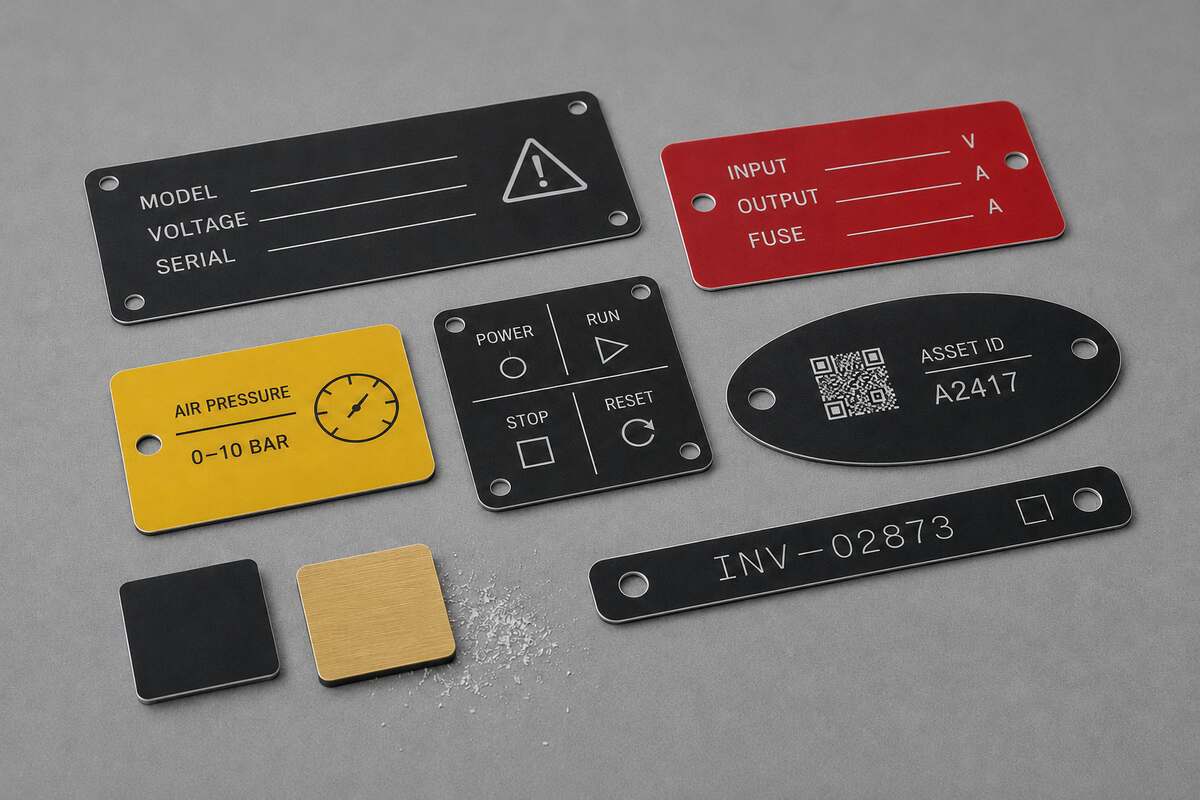
A two-ply ABS engraving sheet uses a thin face color over a continuous contrasting core. Mechanical engraving removes the face in selected areas, leaving recessed information in the core color. The finished quality depends on the relationship between the face construction, cutter geometry, artwork and depth control.
If the tool is too shallow, some face color may remain and contrast will be incomplete. If it is unnecessarily deep, fine characters may widen, small counters may close and production time may increase. A sample should therefore be engraved with the intended cutter, character size and artwork before a volume order is released.
For a broader comparison of two-ply, three-ply, double-sided and reverse-engraving constructions, review the LYSHIRE engraving sheet structure system.
Do Not Select by Color Alone
Two sheets can look similar while using different polymers, cap constructions or approved processing routes. Compatibility must come from the exact supplier specification and a controlled machine test—not from appearance, a generic “plastic” label or an improvised burn test.
CNC and Rotary Setup
A Practical Sample-Test Sequence
- Secure the sheet: use a flat spoilboard, vacuum table or suitable fixture so the engraving surface remains level.
- Select the cutter: match a sharp V-cutter, parallel cutter or routing tool to the required line width, corner detail and cut profile.
- Set a shallow first pass: remove only enough face material to obtain a clean, continuous core-color reveal.
- Inspect detail and edge quality: check small text, holes, inside corners, burrs, chips and the back surface.
- Adjust gradually: refine depth, spindle speed and feed rate according to the machine, cutter, sheet and artwork.
- Record the approved setup: keep the product code, batch, tool, depth and machine parameters with the approved sample for repeat production.
There is no universal parameter that fits every CNC router or rotary engraver. Tool diameter, sharpness, spindle characteristics, workholding and desired finish all affect the result. Effective chip or dust extraction and the machine manufacturer's safety instructions should be followed.
Application Fit
Where ABS Engraving Plastic Is Commonly Used
| Application | Typical information | Important specification |
|---|---|---|
| Control-panel legend | Switch function, circuit reference, ON/OFF or operating instruction | Small-text clarity, dimensions, hole positions and mounting method |
| Equipment nameplate | Model, voltage, serial number or service information | Contrast, variable data, finished size and fabrication drawing |
| Valve, cable or pipeline tag | Identification number, direction or system reference | Hole/slot design, abrasion, environment and attachment method |
| Indoor facility sign | Room, instruction, direction or restricted-area identification | Viewing distance, color system, installation surface and applicable project rules |
| Badge, award or display plate | Name, title, department or recognition text | Surface finish, edge quality, accessory and appearance approval |
Engraving plastic is an identification material, not automatically an electrical-insulation component, safety certification or regulatory sign system. Any regulated application must be assessed against the buyer's complete project requirements.
Process Boundary
Standard LYSHIRE ABS and CO2 Laser Sheet Are Separate Routes
LYSHIRE's standard ABS-based engraving sheet is specified for CNC and rotary processing. For CO2 laser engraving or cutting, LYSHIRE normally recommends its separate PMMA/acrylic-based laser configuration. Keeping the two product routes distinct gives buyers a clearer basis for machine testing and repeat orders.
Industry suppliers may offer individual ABS-containing products that have been tested for more than one processing method. This does not make every ABS sheet laser-compatible. Buyers should follow the data for the exact product rather than extending one supplier's approval to an unidentified sheet.
For laser projects, see LYSHIRE laser engraving sheets. For CNC/rotary capabilities and finished-part options, review the LYSHIRE process system.
Outdoor Use Requires Separate Confirmation
Many ABS engraving laminates in the market are positioned primarily for indoor use. If a project involves sunlight, weather, heat, moisture or chemicals, provide the exposure conditions and approve a tested structure. Do not infer outdoor performance from color or thickness.
Troubleshooting
What Common Mechanical-Engraving Results Usually Indicate
| Incomplete or uneven core-color reveal | Check sheet flatness, workholding, surface level, face variation and whether the engraving depth is too shallow. |
| Fine text becomes too wide | The cutter angle or tip width may be too large, or the tool may be cutting deeper than required. |
| Rough, chipped or fuzzy edge | Inspect tool sharpness, feed, spindle speed, chip removal, sheet support and whether the cutter suits the operation. |
| Melted edge or plastic build-up | Heat input or chip evacuation may be unsuitable. Review the tool, speed, feed and dust extraction. |
| Sheet lifts during routing | Improve vacuum coverage or fixturing, reduce unsupported areas and confirm the sheet is flat before machining. |
| Repeat orders show a different appearance | Confirm product code, face/core colors, finish, thickness, batch and the retained approved sample before processing. |
RFQ Checklist
Information to Send LYSHIRE for an ABS Engraving Sheet Quotation
- Machine and process: CNC router, rotary engraver and any cutting, drilling or finishing steps.
- Face/core colors: required color combination, surface finish and approved reference, if available.
- Dimensions: full-sheet or finished-part size, nominal thickness and quantity.
- Artwork: CAD, AI or PDF file, minimum character size, line width and fixed or variable data.
- Fabrication: holes, slots, corner radius, chamfer, special shapes and edge requirements.
- Mounting: adhesive backing, screws, rivets, badge accessory or another system.
- Environment: indoor/outdoor location, UV, temperature, moisture, chemicals and cleaning method.
- Approval: physical sample, machine trial, color standard and any customer inspection requirement.
- Commercial details: destination country, packaging requirement and delivery schedule.
Frequently Asked Questions
ABS Engraving Sheet FAQ
What machines are standard LYSHIRE ABS engraving sheets designed for?
They are designed primarily for CNC routing and rotary engraving, together with compatible mechanical fabrication such as drilling, sawing or shearing. The exact tool and setup should be approved with a sample.
Can standard LYSHIRE ABS engraving sheet be used with a CO2 laser?
It should not be treated as LYSHIRE's default CO2 laser material. For CO2 work, select the separate PMMA/acrylic-based laser engraving sheet. Always confirm the processing approval for the exact product rather than generalizing from the polymer name.
How deep should an ABS engraving sheet be engraved?
Engrave only deep enough to remove the face cleanly and reveal the continuous contrasting core. The correct depth depends on the product construction, cutter, character size and machine, so a controlled sample is required.
Can ABS engraving plastic be drilled and cut to shape?
Yes. Suitable ABS engraving sheets can be routed, drilled, sawn, sheared and fabricated into holes, slots, rounded corners or special shapes. Finished quality depends on the tool, support and drawing requirements.
Is every ABS engraving sheet suitable for outdoor use?
No. Outdoor, UV, weather, heat and chemical performance vary by product and finish. Buyers should provide the actual service conditions and approve a tested structure instead of assuming that ABS alone guarantees outdoor durability.
What should be included in an ABS engraving sheet inquiry?
Provide the machine, process, face/core colors, finish, thickness, sheet or finished size, quantity, artwork, fabrication, mounting method, service environment, destination country and sample requirements.
Material and Sample Review
Confirm the ABS Structure on Your CNC or Rotary Machine
Send LYSHIRE your machine type, artwork, color structure, dimensions, thickness, fabrication, mounting method and service environment. Our team can recommend the appropriate ABS engraving-sheet route and prepare samples, full sheets, cut blanks or finished identification parts for qualified B2B projects.
Contact LYSHIRETechnical references: official product guidance for rotary/ABS engraving laminates from Gravotech Gravoply 1 and Gravotech Ecocut, plus distributor specifications for Rowmark Mattes. Final selection must follow LYSHIRE's current product specification and the buyer's machine and application validation.