
How Two-Ply Engraving Sheets Create High-Contrast Labels
Two-Ply Engraving Structure
How Two-Ply Engraving Sheets Create High-Contrast Labels
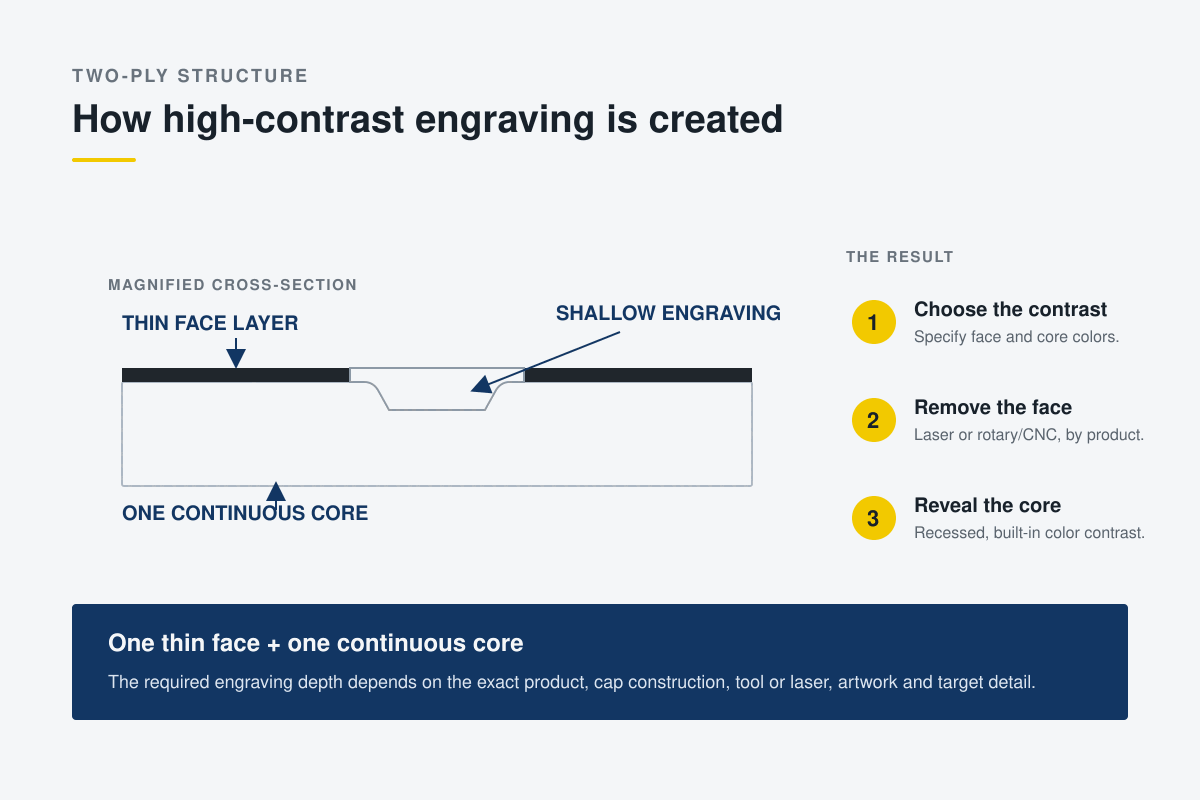
Two-ply engraving sheets are used when a fabricator needs repeatable contrast without adding separate lettering after engraving. The material combines a thin colored face with one continuous core in a different color. Shallow processing removes the face in selected areas and reveals the core as recessed text, numbers, symbols or line graphics.
Direct answer: a two-ply engraving sheet creates contrast through its structure. The face color remains on the unprocessed surface, while laser, CNC or rotary engraving exposes the contrasting core only where the artwork is engraved. The result is not raised lettering and should not look like ink printed on top of the sheet.
Terminology
Two-Ply, Two-Color, Two-Tone and Double Color
International buyers may use several names for the same general material concept. “Two-ply engraving sheet” describes the layered construction most clearly. “2 ply engraving plastic” is a common numeric spelling. “Two-color,” “two-tone” and “double color” emphasize the visible contrast between the face and core.
These terms do not identify the polymer, processing route or service environment by themselves. A sheet can use an ABS-based mechanical-engraving configuration, a PMMA/acrylic-based laser configuration or another supplier-tested structure. The exact product data must therefore be confirmed before it is assigned to a machine.
Material Anatomy
One Thin Face Layer over One Continuous Core
Face Layer
The thin surface layer provides the visible background color and finish. It may be matte, gloss, brushed, mirror, textured or another approved appearance.
Core Layer
The continuous base provides the revealed contrast color. It also forms most of the sheet thickness and supports cutting, drilling and installation.
Engraved Groove
The tool or laser removes the face only where information is required. A controlled shallow groove reveals the core without unnecessary depth.
Why the Structure Is Useful
Five Practical Advantages for Identification Fabricators
| Structural advantage | What it means in production | What still requires confirmation |
|---|---|---|
| Built-in color contrast | Text and symbols appear by exposing the core, so a separate color-filling or printing step may not be required. | Face/core combination, viewing distance and the buyer's color system. |
| Repeatable variable information | One sheet can produce labels with different names, serial numbers, equipment references or QR-code data. | Artwork control, code density, character size and scanning verification. |
| Fine-detail capability | A suitably controlled face construction can support small text and narrow lines when matched to the correct tool or laser. | Minimum line width, cutter geometry, focus, depth and physical sample result. |
| Fabrication flexibility | The same material can be converted into rectangles, tags, drilled plates, rounded corners and special shapes. | Exact polymer, total thickness, cutting method, edge finish and drawing. |
| Consistent background appearance | The unengraved surface keeps its specified finish while the recessed core creates the information. | Batch, surface finish, protective film, cleaning method and approved sample. |
Engraving versus Surface Printing
They Solve Different Identification Requirements
Engraving creates information by removing material. In a two-ply sheet, the resulting text or graphic is recessed into the layered structure. Surface printing places ink, toner or another marking system on top of a substrate. Neither process is universally better.
Two-ply engraving is useful when the project needs simple, high-contrast information, variable data and a machined appearance. Printing may be the better choice for full-color graphics, photographs, gradients or very large quantities with the same design. Some finished products combine engraving with UV printing, screen printing or color filling after process compatibility has been reviewed.
Do Not Overstate Durability
Recessed contrast does not make every engraving sheet automatically outdoor grade, UV resistant, chemical resistant, scratchproof or compliant with a safety standard. Those properties depend on the exact cap, core, polymer, finish, adhesive, installation and service environment.
Select the Correct Process Route
The Layer Concept Does Not Determine the Machine
| LYSHIRE material route | Primary processing method | Buyer guidance |
|---|---|---|
| ABS-based engraving sheet | CNC routing and rotary engraving | Use the LYSHIRE mechanical-processing configuration for engraving, routing, drilling and related fabrication. |
| PMMA/acrylic-based engraving sheet | CO2 laser engraving and cutting | Use the separate LYSHIRE laser configuration and test engraving, cutting, extraction and edge quality. |
| Special or unidentified layered plastic | Only after exact verification | Confirm the supplier's composition and approved technology. Similar appearance does not prove machine compatibility. |
Other manufacturers may approve individual products for both laser and rotary use. Compatibility must be attached to the exact product specification, not generalized from “two-ply,” “ABS” or “acrylic” alone. Buyers can compare LYSHIRE routes in the processing system and laser engraving sheet range.
Depth Control
Remove the Face Cleanly—Then Stop
- Use the intended artwork: include the smallest text, narrowest line and most detailed symbol required by the job.
- Secure and level the material: flatness and workholding affect the consistency of the reveal.
- Start shallow: remove only enough face material to obtain a complete core-color result.
- Inspect the groove: check that the information is recessed, the core is continuous and the face is not left inside the characters.
- Adjust gradually: refine depth, power, speed, focus, feed or cutter selection according to the approved process.
- Retain the sample: record the product code, batch and settings used for repeat orders.
There is no universal engraving depth for every two-ply sheet. Industry product ranges specify different cap constructions and target depths, so the fabricator must follow the selected product data and run a controlled sample.
Troubleshooting
What Common Results Usually Indicate
| Weak or interrupted contrast | The face may not be fully removed, the sheet may not be level, or the selected colors may not provide enough visual separation. |
| Letters become too wide | The engraving is too deep, the cutter angle or tip is too large, or heat input is closing fine details. |
| Information looks printed rather than engraved | The groove may be visually too shallow, flat imagery may have been used for approval, or the surface was marked by a different process. |
| Edge shows an unexpected third color | The supplied material may use another structure, backing or coating. Confirm that the order is genuinely one face over one continuous core. |
| Results vary across one sheet | Review flatness, focus or Z-height, workholding, sheet thickness and face-layer consistency. |
| Outdoor appearance changes | The selected product, color or finish may not be approved for the actual UV, weather, heat, moisture or chemical exposure. |
Buyer Checklist
What to Specify Before Ordering Two-Ply Engraving Sheets
- Machine: CO2 laser, CNC router or rotary engraver.
- Material route: ABS-based mechanical configuration or PMMA/acrylic-based laser configuration.
- Color structure: face color, continuous core color and required contrast.
- Surface: matte, gloss, brushed, mirror, textured or another approved finish.
- Dimensions: sheet or finished size, total thickness, holes, corners, slots and special shapes.
- Artwork: fixed or variable information, minimum text size, line width, QR code or barcode requirements.
- Mounting: adhesive backing, screws, rivets, badge fitting or another method.
- Environment: indoor/outdoor use, UV, temperature, moisture, chemicals and cleaning.
- Approval: physical color sample and processing test before production.
For other constructions—including three-ply, double-sided and reverse-engraving materials—review the LYSHIRE structure system. Finished parts can be discussed through the custom application service.
Frequently Asked Questions
Two-Ply Engraving Sheet FAQ
What is a two-ply engraving sheet?
It is a layered plastic sheet with one thin colored face over one continuous core in a different color. Engraving removes the face in selected areas and exposes the core as recessed, contrasting information.
Are two-ply, two-color and two-tone engraving sheets the same?
They often describe the same general contrast concept, but the terms do not define the polymer, machine route, thickness, finish or outdoor performance. The exact product specification must still be confirmed.
Can the same two-ply sheet be used for laser and rotary engraving?
Only if the exact product is approved for both processes. LYSHIRE normally separates its PMMA/acrylic CO2 laser configuration from its ABS CNC/rotary configuration. Do not assume compatibility from appearance alone.
How deep should a two-ply engraving sheet be engraved?
Only deep enough to remove the face cleanly and expose the contrasting core. The correct depth depends on the selected product, artwork, tool or laser and target detail, so a sample test is required.
Are engraved two-ply labels always suitable for outdoor use?
No. Outdoor performance depends on the exact polymer, face construction, color, finish, adhesive, installation and exposure conditions. Request a product approved and tested for the intended environment.
What information should be included in a two-ply sheet inquiry?
Provide the machine, material route, face/core colors, finish, thickness, size, quantity, artwork, fabrication, mounting method, service environment, destination country and sample requirements.
Structure and Sample Review
Confirm the Face, Core and Processing Route Before Production
Send LYSHIRE your machine type, application, face/core colors, thickness, dimensions, artwork and service environment. Our team can recommend the appropriate two-ply laser, CNC or rotary configuration and arrange sample verification for qualified B2B projects.
Contact LYSHIRETechnical references: Rowmark material glossary, Gravotech engraving-material guidance and Trotec laser engraving plastic guidance. Final material selection and settings must follow LYSHIRE's current product specification and the buyer's validation.