
How to Evaluate UV-Resistant Engraving Plastic for Outdoor Labels
Choosing UV-resistant engraving plastic for an outdoor label is not the same as choosing a color that looks durable. The correct sheet must match the actual sunlight exposure, moisture and temperature conditions, fabrication process, mounting method, cleaning routine and required service period. A material can show good performance in a controlled UV test and still fail in service if the adhesive, substrate, hole design or chemical exposure is ignored.
For a reliable B2B specification, begin with the finished label and its environment. Then select the correct material route, review relevant test evidence and approve a representative sample. At LYSHIRE, PMMA/acrylic configurations are the standard route for CO2 laser processing, while ABS configurations are supplied for CNC and rotary engraving. UV-resistant options must be confirmed for the exact construction ordered.
Quick answer: what should buyers evaluate?
A practical evaluation covers six connected inputs:
- Exposure: sunlight direction, rain, humidity, temperature changes and expected service conditions.
- Fabrication: CO2 laser, CNC or rotary engraving, plus cutting, drilling and edge requirements.
- Visual system: face/core contrast, finish, viewing distance, smallest text and required symbols.
- Installation: mounting substrate, adhesive or fasteners, drainage and hole-to-edge distance.
- Service: cleaners, chemicals, abrasion, impact and inspection frequency.
- Verification: test evidence, a representative sample and written acceptance criteria.
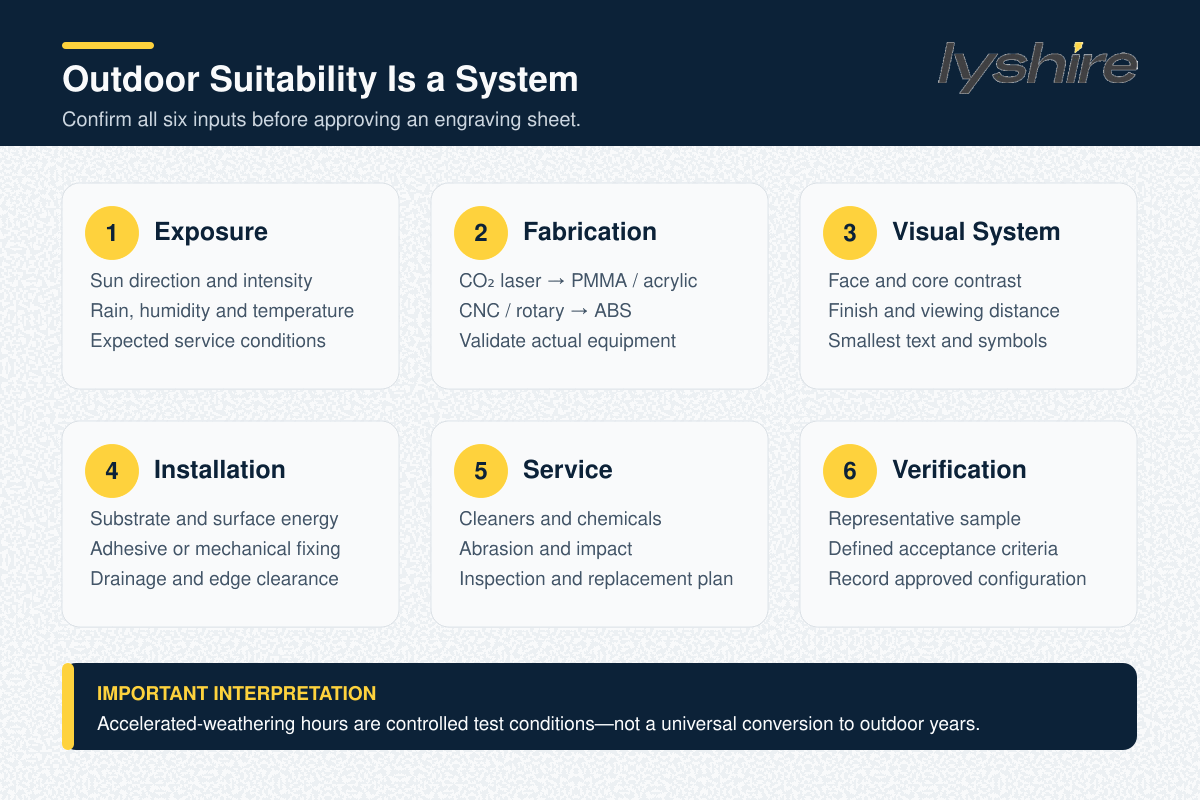
Outdoor suitability depends on material, exposure, fabrication, installation, service conditions and verification—not one property in isolation.
UV resistance is only one part of outdoor suitability
UV resistance describes a material’s ability to limit changes caused by ultraviolet exposure. For an engraving sheet, buyers may be concerned about face-color shift, fading, chalking, loss of gloss, reduced engraving contrast, cracking, warping or separation between layers. These are important questions, but they do not cover every outdoor failure mode.
An installed label may also experience water at the edges, condensation behind the plate, freeze-thaw or hot-cold cycles, chemical cleaners, oils, salt, abrasion, impact and stress around mounting holes. Adhesive performance can be affected by the mounting surface, surface energy, contamination and temperature during application. A sheet described as UV resistant should therefore not be treated as a complete outdoor system without reviewing these additional factors.
The specification should define the exposure that matters to the project. A shaded equipment label under a roof is different from a south-facing identification plate in full sun. A label mounted on a stable indoor/outdoor enclosure is different from a plate attached to a substrate that expands, vibrates or becomes wet. “Outdoor use” is a starting category, not a complete requirement.
Define the exposure before selecting the sheet
Buyers can improve material recommendations by sending a short exposure profile with the RFQ. The profile does not need to be a laboratory document. It should simply make the actual service conditions visible to the supplier.
- installation country or climate region;
- indoor, covered outdoor or fully exposed outdoor location;
- approximate sunlight direction and daily exposure;
- rain, humidity, condensation or wash-down conditions;
- minimum and maximum service temperatures, if known;
- cleaners, oils, fuels, salts or other chemicals;
- expected inspection or replacement interval;
- critical appearance, contrast or legibility requirements.
This information helps separate ordinary exterior identification from a more demanding project that may need application-specific testing or a custom material configuration. It also prevents a buyer from approving a sample under indoor lighting and assuming that the same appearance will be maintained under every exterior condition.
How to read accelerated-weathering evidence
Accelerated-weathering equipment exposes specimens to controlled cycles using defined lamps, temperature and moisture conditions. Fluorescent UV methods are used to evaluate changes caused by UV radiation, heat and water under laboratory conditions. The value of the test is repeatability: samples can be compared using a documented procedure and duration.
LYSHIRE’s available UV Weathering Resistance Test Report records a 336-hour UVA-340 exposure conducted to GB/T 16422.3-2022. The recorded visual result states that there was no obvious surface change and no blistering, delamination, cracking or deformation under the reported conditions.
That result is useful evidence for the tested specimen and test conditions. It should not be converted into a universal claim such as “336 hours equals a fixed number of outdoor years.” Real-world weathering depends on geography, altitude, orientation, season, temperature, rainfall, pollutants, installation and the property being measured. Even when two locations receive similar total sunlight, different moisture and temperature cycles can produce different material responses.
When comparing reports, check the lamp type, cycle, temperature, moisture exposure, total duration, specimen construction and evaluation method. Confirm that the report applies to the same color, polymer route and surface construction being quoted. A report for one product family should not automatically be assigned to every color or configuration.
Match the polymer route to the fabrication process
UV performance cannot compensate for an incorrect processing route. A sheet that resists weathering but engraves poorly on the buyer’s equipment is not a successful specification.
CO2 laser processing
For LYSHIRE projects, PMMA/acrylic is the standard material route for CO2 laser engraving and cutting. The laser removes the thin face layer to reveal the contrasting core. Power, speed, focus, lens condition, extraction and artwork all affect the result. A sample should include the smallest text, narrowest line and actual contour edge expected in production.
CNC and rotary processing
ABS is the standard LYSHIRE route for CNC and rotary engraving. Tool geometry, spindle speed, feed, depth, hold-down and chip removal determine engraving clarity and edge quality. If the job includes holes, slots, bevels or shaped profiles, those features should be included in the approval drawing and sample.
PMMA can also be CNC cut or drilled when the job and configuration are suitable. However, buyers should not infer a universal “dual-process” claim from the material name alone. The quotation and sample record should identify the exact polymer, process and configuration approved for the order.
Specify the visual system, not just the color name
An outdoor label must remain readable, not merely retain a general color impression. The face/core combination, finish, character size, line width and viewing distance work together as a visual system. A high-contrast combination can improve recognition, but contrast should be checked on the engraved sample rather than assumed from digital color values.
Matte finishes can help control reflections in many industrial settings. Gloss or special finishes may be appropriate when the project requires a particular appearance, but glare and viewing angle should be evaluated. Color descriptions such as red/white or black/yellow are not substitutes for an approved physical reference, especially when the label must match an existing facility standard.
The sample should reproduce the most demanding real feature: the smallest legend, narrowest border, densest symbol, shallowest engraving depth or tightest hole position. A large decorative logo is not a meaningful approval sample if the production order contains small serial numbers and detailed electrical references.
Mounting design can determine service performance
Adhesive backing is convenient, but its performance depends on more than the engraving sheet. The receiving surface must be clean, dry and compatible with the adhesive. Rough, contaminated, low-surface-energy or frequently wet substrates may require a different attachment method or an application-specific adhesive evaluation.
Mechanical fasteners can be appropriate for equipment plates, but the drawing should define hole diameter, hole-to-edge distance, fastener type and tightening method. Over-tightening can introduce stress. The assembly should allow for normal dimensional movement and should not trap water behind the label where drainage is needed.
For critical outdoor identification, consider the sheet, backing, substrate and installation procedure as one system. Approving only the unmounted sheet leaves a major part of the application untested.
Include cleaning, chemicals and abrasion in the specification
Outdoor labels on industrial equipment may be cleaned more aggressively than architectural signs. Detergents, alcohols, oils, fuels, disinfectants, alkaline cleaners or solvents can contact the surface. Abrasion from wiping, dust or tools can also affect appearance and legibility.
List the actual cleaning agents and approximate frequency whenever possible. Avoid asking only for “chemical resistance,” because that phrase does not identify the chemical, concentration, contact time or temperature. If exposure is important, a small sample test using the intended cleaning method provides more useful evidence than a general statement.
A practical sample-approval plan
A representative sample connects the written specification to real production. It should be made from the quoted construction and processed on the intended equipment or an agreed equivalent. Record the material identification, face/core color, finish, thickness, sheet size, adhesive option and processing route.
Useful acceptance checks include:
- engraving contrast and absence of face-color residue;
- legibility of the smallest required text and symbols;
- edge quality, dimensions, holes, slots and bevels;
- flatness and visible surface condition;
- adhesion to the real mounting substrate, when relevant;
- appearance before and after any agreed exposure or cleaning test;
- packing and protective-film requirements.
The approved sample should not be separated from the order specification. Keep photographs, settings or cutter details, drawing revision and acceptance notes with the project record. This creates a practical reference for batch inspection and future repeat orders.
Common specification mistakes
| Mistake | Why it creates risk | Better instruction |
|---|---|---|
| Requesting “outdoor plastic” only | The actual UV, moisture, temperature and chemical exposure is unknown. | Send a short exposure profile and expected service conditions. |
| Converting test hours directly to years | No universal conversion represents every climate, orientation and failure mode. | Use the report as controlled comparative evidence and validate the application. |
| Choosing by color and thickness | The sheet may not match the intended laser or mechanical process. | State CO2 laser or CNC/rotary before material selection. |
| Ignoring mounting details | Adhesive, substrate or fastener stress can cause failure even when the sheet is suitable. | Approve the installation system, not only the unmounted sheet. |
| Approving an easy sample | Large simple artwork may not reveal problems with fine text, holes or edges. | Test the most demanding production features. |
Information to send with an RFQ
For an efficient recommendation, send LYSHIRE the application, location, processing method, face/core colors, finish, thickness, sheet size, finished-part drawing, mounting method, environment, quantity and packing needs. Include the smallest text or line and identify any required holes, slots, bevels or adhesive backing.
Buyers can first review LYSHIRE’s UV Resistant Sheets, then compare broader Outdoor Grade Sheets and typical Industrial Label applications. The commercial page remains the main product-selection destination; this guide explains how to prepare the specification.
Frequently asked questions
Is UV-resistant engraving plastic automatically suitable for every outdoor application?
No. UV resistance addresses one part of outdoor exposure. Moisture, temperature changes, chemicals, abrasion, mounting stress and the substrate must also be reviewed for the specific project.
Does a 336-hour UVA-340 result equal a fixed number of outdoor years?
No. Accelerated-weathering hours describe controlled test exposure. They should not be converted into a universal outdoor lifetime because climate, orientation, moisture, temperature and evaluation criteria vary.
Which LYSHIRE material route is used for CO2 laser engraving?
PMMA/acrylic is the standard LYSHIRE route for CO2 laser engraving and cutting. The exact grade, thickness and settings should be validated with the buyer’s real artwork and equipment.
Which material route is used for CNC or rotary engraving?
ABS is the standard LYSHIRE route for CNC and rotary engraving. Tool geometry, speed, feed, depth, hold-down and chip removal should be confirmed during sample approval.
Should adhesive-backed outdoor labels be tested on the real substrate?
Yes. Adhesive performance depends on the substrate, surface condition, application temperature and exposure. Testing only the free sheet does not validate the installed assembly.
What should a buyer include in a sample request?
Include the process, colors, finish, thickness, drawing, smallest text, holes or profiles, adhesive requirement, mounting substrate, exposure conditions and acceptance criteria. The sample should reproduce the most demanding production feature.
Build the decision around the finished outdoor label
The strongest material decision is not based on one adjective or one test duration. It connects the exposure profile, polymer and fabrication route, visual requirements, mounting system, service conditions and a documented sample approval. This approach gives buyers a clearer basis for comparison and gives the supplier enough information to recommend an appropriate UV-resistant configuration.
For a project review, send the intended environment, equipment type, artwork, color structure, thickness, mounting method and quantity. LYSHIRE can evaluate the request, recommend a suitable configuration and prepare samples for processing and application checks.
Need help confirming the right outdoor label material?
Send the application environment, processing method, artwork, color structure, thickness, mounting method and quantity. LYSHIRE can review the requirements and prepare a representative sample.
Reference note: ISO 4892-3:2024 describes fluorescent UV lamp exposure methods for plastics; ASTM G154 covers operation of fluorescent UV apparatus for nonmetallic materials. Test reports should be interpreted according to their stated specimen, cycle and evaluation conditions.