
Laser vs. Rotary Engraving Plastic: How to Choose the Right Sheet
Laser vs. rotary engraving plastic selection is not simply a question of which machine is faster. The sheet construction, base polymer, cap thickness, artwork, finished-part requirements and production volume must all match the process. A material selected only by color or thickness may engrave poorly, create excessive residue, chip at the edge or require costly rework.
For professional buyers, the safest starting point is to define the equipment and finished application before requesting a sheet. LYSHIRE supplies separate material routes for CO2 laser processing and CNC/rotary engraving: PMMA (acrylic) engraving sheets are the standard laser route, while ABS engraving sheets are supplied for rotary and CNC processing. Some materials in the wider market are promoted as dual-process products, but that capability must be confirmed for the exact grade rather than assumed from the words “engraving plastic.”
Quick answer: which engraving sheet should you choose?
CO2 Laser Route
Choose a laser engraving sheet when the job depends on non-contact processing, fine graphics, rapid changes between designs, complex contours or efficient production of variable information. For LYSHIRE, this normally means a PMMA (acrylic) sheet developed for CO2 laser engraving and cutting.
Rotary / CNC Route
Choose a rotary engraving sheet when the job requires controlled mechanical depth, deep recessed characters, bevelled edges, drilling, routing or integration with an established CNC workflow. For LYSHIRE, this normally means an ABS sheet developed for rotary engraving and CNC fabrication.
Selection principle: Neither route is automatically better. The correct choice is the combination that produces the specified contrast, edge quality, depth, tolerance and throughput on the buyer’s actual equipment.
A laser vs. rotary engraving plastic comparison should begin with the production requirement, not a generic list of machine advantages.
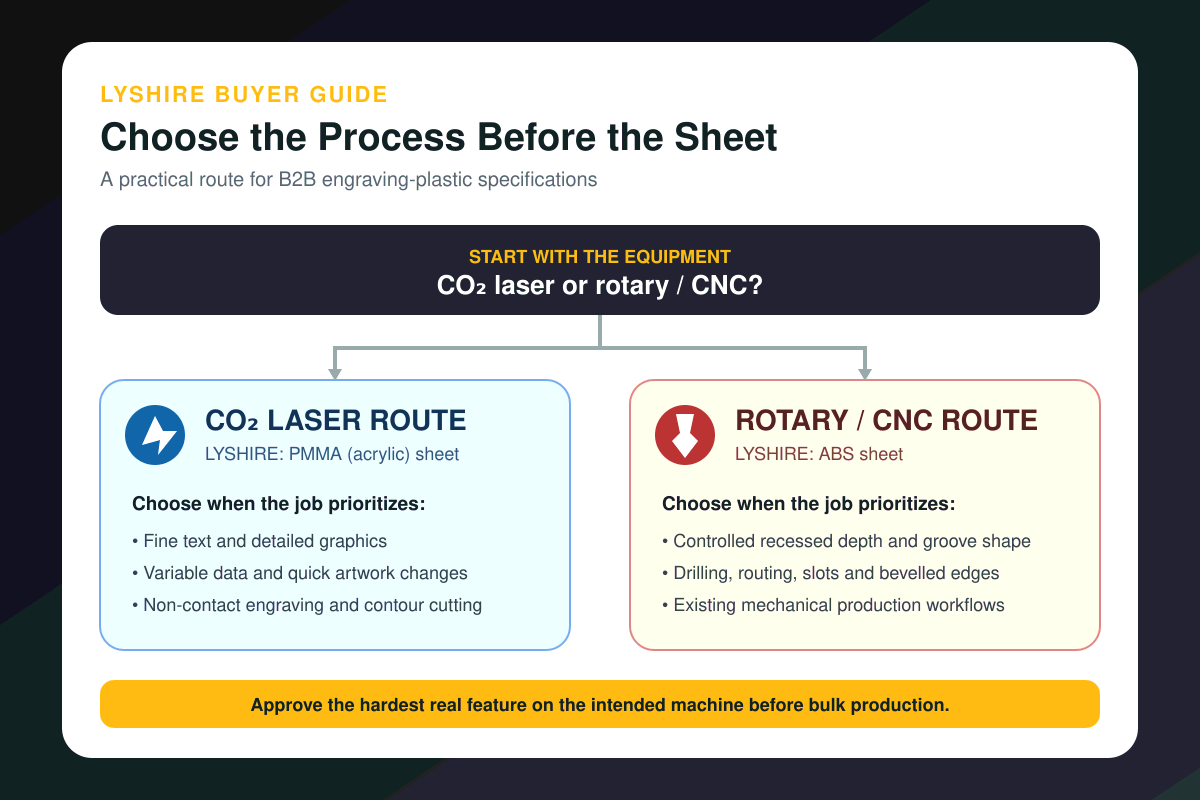
Choose the processing route first, then confirm the sheet construction and approve a representative sample.
Laser and rotary engraving remove the surface differently
Both processes can reveal a contrasting core beneath a thin surface layer, but the removal mechanisms are different.
A CO2 laser uses focused energy to remove the cap and, when required, cut the profile without a tool touching the sheet. The beam follows vector or raster artwork, which makes it practical for fine text, logos, serial numbers and frequent design changes. The result depends on laser power, speed, frequency or pulse settings, focus, lens condition, extraction and the formulation of the material.
A rotary or CNC system uses a physical cutter. Tool geometry, spindle speed, feed rate, depth, hold-down and material flatness determine how cleanly the cap is removed. Mechanical engraving can provide direct control over groove width and depth and can be combined with drilling, beveling and profile routing. Cutter wear and chip evacuation must be managed during longer production runs.
This difference changes more than the machine setting. It affects which polymer should be purchased, how the artwork is prepared, how the sheet is held, what finishing steps are needed and how repeatability should be inspected.
Start the RFQ with the machine, not the color
A request such as “black/white, 1.5 mm” is incomplete. It describes the visible combination and thickness, but it does not tell the manufacturer whether the buyer will use a CO2 laser, a rotary engraver or a CNC router. Two sheets can look almost identical before processing while being built for different production routes.
A useful RFQ should state:
- machine type and, where relevant, model or working area;
- CO2 laser or rotary/CNC processing route;
- face color, core color and required finish;
- sheet size and nominal thickness;
- finished label dimensions and smallest text or line;
- whether profiles, holes, slots or bevels are required;
- adhesive-backing requirements and mounting surface;
- indoor or outdoor service and any relevant UV, chemical or cleaning exposure;
- annual demand, order quantity and packing requirements.
This information lets the supplier recommend a construction rather than merely quote a color.
Material compatibility is the first technical filter
“Plastic” covers many polymers and formulations, and they do not react identically to heat or mechanical cutting. Machine compatibility must therefore be specified at product level.
LYSHIRE uses PMMA (acrylic) as the standard material route for laser engraving sheets. A laser removes the thin surface layer to reveal the contrasting acrylic core and can cut the finished outline when the grade and thickness are suitable. The non-contact process avoids cutter load and allows closely spaced graphics.
LYSHIRE uses ABS as the standard material route for CNC and rotary engraving sheets. A cutter removes the cap and creates a recessed legend in the contrasting core. ABS is not presented as the LYSHIRE laser route. Buyers using mechanical equipment should also confirm cutter type, intended depth and whether the job includes drilling or profile routing.
There are products elsewhere in the engraving market that are rated for both laser and rotary work. That does not make every engraving laminate dual-process. The supplier’s specification for the exact sheet takes priority over a general material name.
When laser engraving plastic is usually the stronger choice
Fine text and detailed graphics
Laser processing is well suited to small characters, dense symbols, logos and intricate line work because there is no cutter diameter defining the narrowest feature. The practical limit still depends on the cap, contrast, focus and artwork, so the smallest real feature should appear in the approval sample.
Variable data and frequent artwork changes
Serial numbers, asset codes, changing equipment legends and short batches can be produced without changing a physical cutting tool. This can reduce setup time when the job contains many designs or frequent revisions.
Non-contact processing
The laser does not apply mechanical load through a cutter. That can help with thin details and reduces tool-wear variables. The sheet still needs to lie flat and the extraction system must be appropriate for the approved material.
Integrated engraving and contour cutting
Many label designs can be engraved and cut from the same artwork. This is useful for curved profiles, closely nested parts and projects with many shape variations. Edge appearance and heat input should be checked on the actual sheet rather than predicted from another acrylic grade.
When rotary or CNC engraving plastic is usually the stronger choice
Controlled recessed depth
A mechanical cutter provides direct Z-axis control. This is valuable when the drawing defines a groove, recessed legend or tactile difference that must be checked physically. The depth must still match the cap and core construction; cutting too shallow can leave face-color residue, while cutting unnecessarily deep can widen fine features.
Drilling, routing and beveling
Industrial labels often need mounting holes, slots, shaped profiles or bevelled edges. A CNC workflow can combine these operations in one setup. Tool diameter, inside-corner radius and hole-to-edge distance should be included in the drawing.
Existing mechanical production systems
Buyers with established rotary engraving equipment, cutters, fixtures and trained operators may achieve more predictable output by choosing a sheet developed for that workflow. Replacing the machine is rarely justified by a material comparison alone.
Jobs that require specific cutter geometry
Some work depends on a defined stroke profile, bevel or paint-filled groove. These are mechanical-design requirements, not simply image-resolution requirements. A representative sample should use the intended cutter and depth.
Compare the finished part, not just the engraving step
Purchasing decisions often focus on the time needed to reveal the second color. The real cost is the total finished-part process. A useful laser vs. rotary engraving plastic cost comparison includes setup, engraving, cutting, drilling, cleaning, rejects, tool replacement, extraction, handling and packing.
| Decision factor | Laser route | Rotary/CNC route |
|---|---|---|
| LYSHIRE base-material route | PMMA (acrylic) | ABS |
| Removal method | Focused, non-contact energy | Physical rotating cutter |
| Typical strength | Fine detail, variable data, complex contours | Controlled depth, drilling, beveling and routing |
| Main setup variables | Power, speed, focus, lens and extraction | Cutter, speed, feed, depth, hold-down and chip removal |
| Common production risk | Heat effects, residue or incomplete cap removal | Tool wear, chipping, burrs or inconsistent depth |
| Approval priority | Smallest feature, edge and contrast | Depth, groove width, edge and hole quality |
The table is a selection framework, not a promise that every product in a broad material family performs the same way. Exact product specifications and sample tests remain necessary.
Do not use the engraving process to infer outdoor performance
Laser compatibility does not prove outdoor durability, and a mechanically engravable ABS sheet is not automatically suitable for exterior service. UV exposure, moisture, temperature cycling, chemicals, cleaning agents and mounting stress are separate specification questions.
If the label will be used outdoors or in an industrial environment, the buyer should identify the exposure and request the relevant product information or test evidence. A general statement such as “weatherproof” is less useful than defining the intended environment, expected service period and acceptance criteria.
For LYSHIRE projects, UV-weathering and other available test information should be discussed against the exact requested construction. A visual sample confirms color and processing, but it does not replace a test requirement for the final application.
Artwork requirements differ between laser and rotary production
Laser artwork may combine raster engraving, vector scoring and vector cutting. The file should separate these operations clearly and avoid duplicate lines. Small text should be converted to outlines or supplied with the required fonts, and the final dimensions should be stated.
Rotary artwork must also account for cutter geometry. A cutter cannot create an internal corner sharper than its effective radius, and the tool width affects closely spaced features. Separate layers should identify engraving, profile cutting, holes, slots and any bevel operation. The drawing should include tolerances that matter to assembly.
For either process, the supplier should receive actual-size vector artwork when available. Screenshots are useful for reference but should not become the only production file.
Use a representative sample, not a decorative sample
A sample is most useful when it tests the most difficult part of the future order. A simple large logo may look excellent while the smallest serial number, narrow border or tight hole spacing fails in production.
The approval sample should include:
- the smallest text and narrowest line;
- the closest spacing between adjacent features;
- at least one typical filled area or dense graphic;
- the intended profile edge, hole or slot;
- the real face/core color combination and finish;
- the intended adhesive backing, if used;
- the target laser settings or cutter and depth record;
- an acceptance photograph or signed physical sample.
A small parameter matrix is often more valuable than a single “best” setting. Laser users can vary power and speed within a controlled test field. Rotary users can compare depth or feed while holding the cutter constant. The final record then becomes the starting point for batch control.
Common mistakes that increase reject rates
Assuming one physical sheet works on every machine
The phrase “laser and rotary engraving plastic” may describe a supplier’s total range rather than one universal sheet. Confirm the exact base polymer and process recommendation on the quotation and sample label.
Buying on sheet price alone
A lower sheet price can be offset by slower processing, frequent cleaning, cutter replacement, failed small text or inconsistent depth. Compare cost per accepted finished part.
Copying settings from another product
Color, cap thickness, formulation, sheet thickness, lens, machine power and tool condition can change the result. Previous settings are a starting reference, not a guaranteed production recipe.
Using an easy sample
A sample that excludes the most demanding feature cannot validate the job. Test the smallest, deepest, closest and most dimension-sensitive elements before approving a bulk order.
Treating process compatibility as a durability claim
How a sheet is engraved does not establish its UV stability, chemical resistance, impact performance or warranty. Those requirements must be specified separately.
A practical B2B selection sequence
The following laser vs. rotary engraving plastic sequence turns a broad material request into a production-ready specification.
- Define the machine. State CO2 laser or rotary/CNC and identify important equipment limits.
- Define the finished part. Provide dimensions, smallest features, holes, edges, backing and tolerances.
- Select the material route. For LYSHIRE, use PMMA (acrylic) for the laser range and ABS for the rotary/CNC range.
- Confirm the construction. Record face color, core color, surface finish, structure, thickness and sheet size.
- Define the environment. Separate indoor/outdoor, UV, moisture, temperature and chemical requirements from machine compatibility.
- Approve a representative sample. Test the hardest real feature on the intended equipment.
- Record the process window. Keep the approved laser or cutter conditions with the material batch.
- Inspect batch output. Check contrast, depth, edges, dimensions, holes, backing and packing against the approved reference.
Buyers can compare LYSHIRE’s process-based material routes in the Laser and Rotary Engraving Materials system, then review the dedicated Laser Engraving Sheets and Rotary Engraving Sheets categories.
Frequently asked questions
Can the same engraving plastic sheet be used for laser and rotary engraving?
Only when the exact product is specified for both processes. Do not assume dual-process compatibility from appearance, color or the general term “engraving plastic.” LYSHIRE’s standard route separates PMMA (acrylic) laser sheets from ABS rotary/CNC sheets.
Is laser engraving always faster than rotary engraving?
No. Total production time depends on artwork, engraving area, depth, number of parts, cutting and drilling operations, setup and cleaning. Compare the complete finished-part workflow rather than engraving time alone.
Which process is better for small text?
CO2 laser processing is often preferred for very fine text and detailed graphics because no cutter diameter limits the feature in the same way. However, the actual cap, focus, settings and contrast must be validated with the smallest real text.
Which process is better for deep industrial legends?
Rotary or CNC engraving is often selected when controlled recessed depth, groove geometry, drilling or beveling is important. The cutter and depth must be matched to the sheet construction and drawing.
Does laser or rotary compatibility mean the sheet is outdoor grade?
No. Processing compatibility and outdoor performance are separate properties. UV, moisture, temperature, chemicals and expected service life should be specified for the exact material.
What information should a buyer send for a material recommendation?
Send the machine/process, face and core colors, finish, thickness, sheet size, finished-part drawing, smallest feature, holes or profiles, adhesive requirement, environment, order quantity and packing needs. A representative artwork file will improve sample accuracy.
Choose the sheet as part of the production system
The right engraving plastic is not the sheet with the longest list of general claims. A sound laser vs. rotary engraving plastic decision identifies the sheet whose polymer, surface construction and dimensions fit the machine and whose approved sample meets the finished-part requirement.
For a B2B material review, send LYSHIRE your equipment type, artwork, application environment, color structure, thickness and expected quantity. The technical team can recommend the appropriate laser or rotary/CNC route and prepare samples for processing evaluation before bulk production.