

How to Evaluate Engraving Plastic Sheet Quality for Industrial Identification
Direct answer High-quality engraving plastic should provide a clean surface, consistent color, stable thickness, good flatness and a sharp contrast after engraving. Buyers should also confirm that the sheet structure matches the intended laser, rotary or CNC process. A color that looks attractive in a catalog is not enough; sample engraving and batch-control information are more reliable purchasing checks.
Engraving plastic is widely used for industrial nameplates, equipment labels, electrical labels, safety signs, control-panel identification and other applications where information must remain clear and repeatable. In these projects, material quality affects more than appearance. It influences engraving accuracy, production efficiency, finished-sign consistency and the risk of rework.
This guide explains the practical characteristics buyers should review before approving an engraving plastic sheet for production. It complements our separate material guide, which explains engraving-sheet structures, by focusing on quality evaluation rather than material definitions.
1. Inspect Surface Cleanliness and Finish
The surface should be visually even and free from obvious dust marks, pinholes, contamination, scratches or irregular gloss. These defects can become more noticeable after engraving or after a high-tack protective film is removed.
For a matte sheet, the texture should remain uniform across the usable area. Brushed, mirror and pearlescent finishes should also have a consistent direction and appearance. Surface cleanliness is particularly important for small text, serial numbers and detailed industrial labels, because minor defects can reduce the professional appearance of the finished part.

2. Check Engraving Contrast and Edge Definition
A two-ply engraving sheet works by removing the thin face color to reveal the contrasting core. Good material should therefore produce a clear, even color transition without requiring excessive engraving depth.
What to look for
Sharp characters, clean corners, uniform exposed core color and consistent line width across the engraved area.
What may indicate a problem
Uneven contrast, fuzzy edges, excessive burrs, incomplete face-layer removal or a need to engrave unnecessarily deep.
Engraving results also depend on machine settings, tool condition, focus and extraction. For this reason, the most useful evaluation is a controlled sample test using the buyer's normal equipment and typical text or graphics.
3. Match the Sheet to the Engraving Process
Material structure should be selected according to the intended process. LYSHIRE commonly uses an ABS-based structure for rotary and CNC engraving sheets, while sheets intended for laser engraving commonly use a PMMA/acrylic base. Using the correct structure helps achieve cleaner processing and more predictable results.
| Evaluation point | Rotary / CNC engraving | Laser engraving |
|---|---|---|
| Typical LYSHIRE base material | ABS-based engraving sheet | PMMA/acrylic-based engraving sheet |
| Key quality check | Clean cutting, controlled chip formation and sharp engraved edges | Clean face-layer removal, clear contrast and controlled heat effect |
| Recommended approval method | Test with the intended cutter, depth and feed settings | Test with the intended laser type, focus, power and speed |
For more process-specific guidance, review the LYSHIRE engraving process system or the laser engraving sheet range.
4. Verify Thickness, Flatness and Dimensional Stability
Thickness influences engraving depth, cutting settings, part rigidity and installation. A buyer should confirm both the nominal thickness and the acceptable tolerance for the application. Sheets should also lie reasonably flat and remain dimensionally stable during normal storage and processing.
Flatness becomes especially important when producing long equipment labels, control-panel strips or multiple small components from one sheet. Excessive warping can affect laser focus, rotary engraving depth and cutting accuracy.
5. Review Color Consistency and Batch Control
For industrial identification programs, replacement labels may be ordered months or years after the first project. Stable color control therefore matters more than simply matching one attractive sample.
LYSHIRE maintains standard formulas for regular colors such as black, white, red, blue, yellow, gold and pearlescent shades. During production, trained operators inspect the sheet and use measuring equipment to support color comparison rather than relying only on visual judgment.
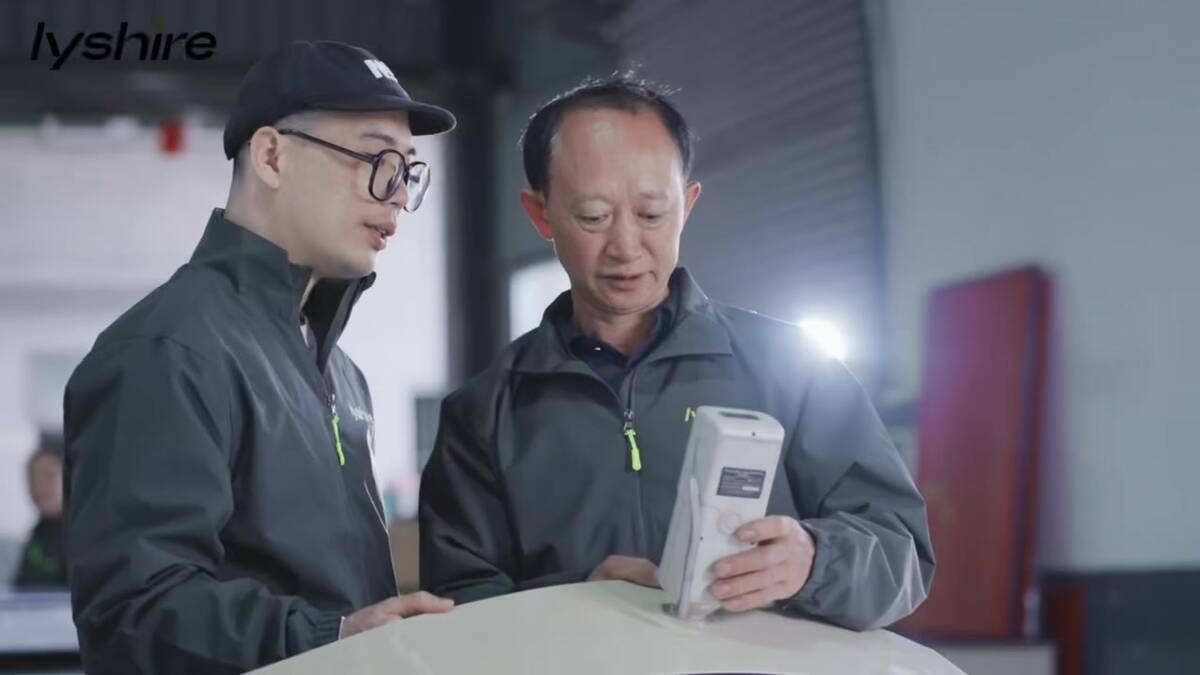
Raw-material and color-masterbatch consistency also affects the final shade. LYSHIRE uses stable primary suppliers and controlled material ratios to reduce variation. Before bulk production, color is calibrated and an initial quantity is checked. Where practical, one customer order is produced in the same batch so that sheets from visibly different production batches are not mixed in the shipment.
How custom colors are controlled
- The customer provides a color code or a physical reference sample.
- LYSHIRE prepares a matching sample and sends the physical sample for approval.
- After approval, the formula and approved reference are retained in the customer's project file.
- Future production is checked against the retained standard and internal QC record.
Important: Color display on phones and computer monitors is not sufficient for final color approval. A physical sample is the appropriate reference for custom colors and long-term identification programs.
6. Confirm Performance for the Real Application
The best sheet is the one that fits the actual environment. Indoor control-panel labels, outdoor equipment identification and frequently cleaned industrial signs may require different surface finishes, adhesives and performance checks.
Depending on the project, buyers may need to review UV resistance, cleaning-chemical exposure, heat conditions, adhesive selection and expected service life. LYSHIRE engraving sheets have RoHS documentation, and Anti-UV options or testing information can be discussed for relevant outdoor applications. Requirements should be confirmed against the exact product structure rather than assumed for every decorative surface.

7. Use a Sample Test Before Bulk Purchasing
A sample test allows the buyer to evaluate appearance and processing under real production conditions. The test should use the intended machine, typical character size, normal engraving depth and the actual cleaning or installation method whenever possible.
| Sample check | Why it matters |
|---|---|
| Surface and color | Confirms finish, cleanliness and visual consistency. |
| Engraving test | Confirms contrast, detail, edge quality and suitable processing settings. |
| Cutting and fabrication | Checks cutting behavior, corner quality, holes and special shapes. |
| Installation method | Confirms whether the sheet, adhesive or fastening method suits the application. |
| Application environment | Identifies whether outdoor, UV, heat or chemical-resistance requirements need additional confirmation. |
LYSHIRE can prepare sample sheets according to the customer's engraving method, preferred thickness and color requirements. Custom colors, special structures and larger samples may require additional confirmation before preparation.
Frequently Asked Questions
What is the most important sign of a good engraving plastic sheet?
No single feature is enough. A reliable sheet should combine a clean surface, clear engraving contrast, stable thickness, suitable flatness, consistent color and compatibility with the intended engraving process.
Can the same engraving plastic be used for both laser and rotary engraving?
Some products may work with more than one process, but the material structure should be confirmed first. LYSHIRE normally recommends ABS-based sheets for rotary/CNC engraving and PMMA/acrylic-based sheets for laser engraving.
How should a custom color be approved?
The customer should approve a physical sample prepared from a color code or supplied reference. Monitor images should not be used as the final standard because screens display color differently.
How can buyers reduce color variation between sheets?
Ask the supplier about formulas, raw-material control, instrument-assisted comparison and batch management. For one project, production from the same controlled batch helps reduce visible variation.
Should buyers test a sample before placing a bulk order?
Yes. A test using the buyer's actual machine, settings and application provides more useful evidence than reviewing color or specifications alone.
Evaluate LYSHIRE Engraving Plastic for Your Application
Tell us your engraving method, thickness, color, application, quantity and performance requirements. The LYSHIRE team can recommend a suitable material structure and prepare samples for testing before bulk production.
Contact LYSHIRE for Samples or a Quote