

How to Specify Three-Ply Engraving Sheets for Multi-Color Signs
Three-Color Structure and Depth Control
How to Specify Three-Ply Engraving Sheets for Multi-Color Signs
A true three-ply engraving sheet can display the original face color plus two different recessed colors. The result depends on an ordered face, middle and base structure—and on controlling two engraving depths accurately. Buyers therefore need to specify more than “3 ply plastic” on a purchase order.
Direct answer: define the three colors in order, identify which artwork must reveal the middle layer and which must reach the base, select a process-specific material for CO2 laser or CNC/rotary work, and approve both depths on a physical sample before bulk production.
What Three-Ply Means
One Thin Sheet, Three Integral Color Levels
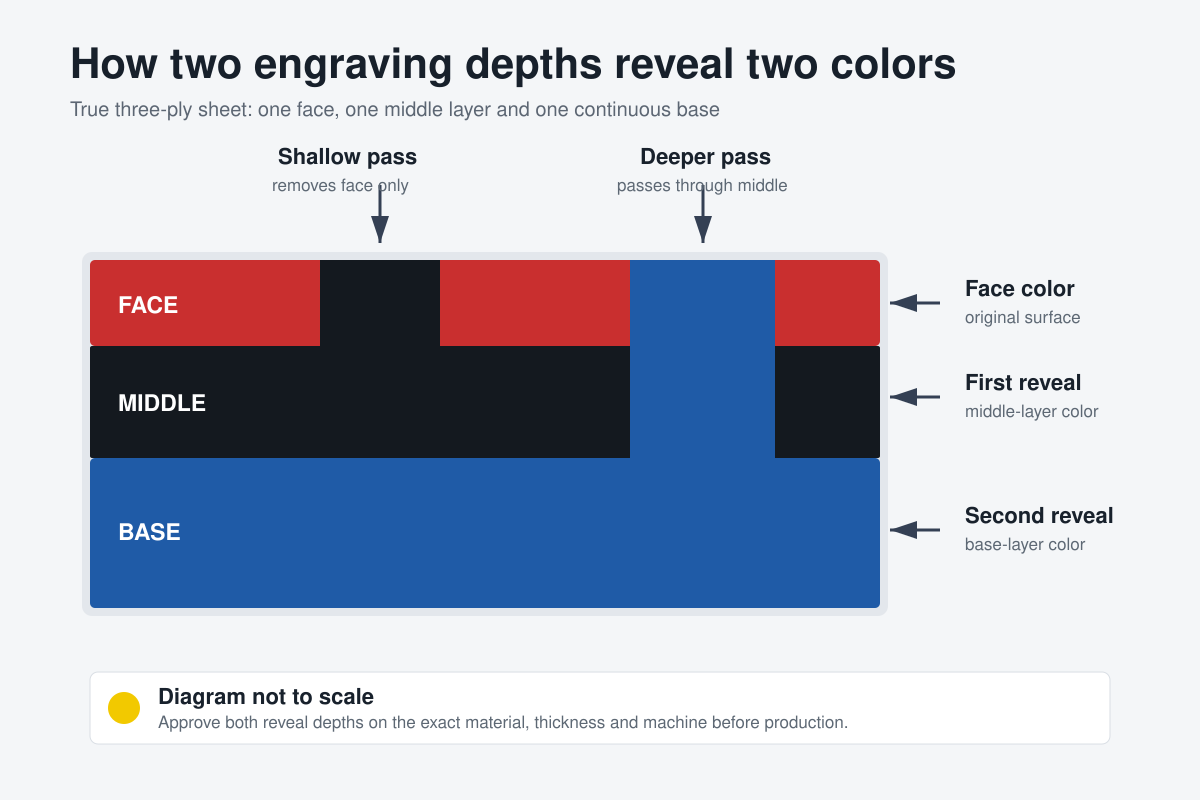
In the LYSHIRE three-ply system, the finished sheet contains a face color, a middle color and a continuous base color. Shallow engraving removes the face and exposes the middle layer. A controlled deeper pass also removes the middle layer and reaches the base. The face remains visible wherever the design is not engraved.
This is not the same as fastening three thick boards together, printing two colors onto a sheet or filling engraved areas with paint. For example, a 1.5 mm red/black/blue sheet can use red as the original face, black for shallow text and blue for selected deeper fields—all inside one finished 1.5 mm sheet.
Order the Colors
Write the Color Sequence from Face to Base
Face Color
The visible background before engraving. It usually carries the largest uninterrupted color area and strongly influences glare, maintenance and sign appearance.
Middle Color
The first reveal color reached by shallow engraving. It commonly carries primary text, headings, outlines or warning legends.
Base Color
The second reveal color reached by a deeper pass. It can identify a second information level, status field, zone or selected symbol.
Always write the order explicitly—such as red face / black middle / blue base. A list that says only “red, black and blue” is ambiguous because reversing the order changes both the background and the colors produced at each engraving depth.
Color Logic
Assign Each Color a Defined Information Function
| Example structure | Possible layout logic | Buyer checks |
|---|---|---|
| Red / black / blue | Red background, shallow black warnings or legends, deeper blue secondary codes or fields. | Confirm that the selected colors match the project’s visual system and are not being used as the only safety or status signal. |
| White / red / green | White background, shallow red alarm or stop information, deeper green ready or normal information. | Add wording, symbols or position so critical meaning does not depend only on red versus green. |
| White / black / green | White background, shallow black instructions, deeper green headers, panels or selected guidance symbols. | Confirm finished-sign rules, contrast, symbol design and installation conditions separately. |
| Custom three-color order | Brand, wayfinding, machine zones, product families or two levels of technical data. | Approve physical colors and both reveal depths; screen colors are not a manufacturing standard. |
The material provides color layers; it does not automatically make the finished sign compliant. Safety colors, accessibility, symbols, wording, character size and mounting must follow the destination market and project specification.
Two Depth Groups
Separate the Artwork before It Reaches the Machine
A production file should clearly identify which objects belong to the shallow middle-color pass and which belong to the deeper base-color pass. Use separate named layers or approved spot colors in the vector file, then lock the mapping in the job sheet. Text, symbols, filled panels and cut lines should not rely on operator memory.
Design the deeper areas with enough width and spacing for the selected process. A depth change can alter apparent line width, corner radius and small-detail definition. The narrowest stroke and smallest character must therefore be present in the approval sample.
No Universal Depth Number
Published depths for another manufacturer’s product are not automatically suitable for a LYSHIRE sheet. Layer proportions, polymer, cap construction, machine power, focus, cutter geometry and calibration all affect the result. Establish two approved production settings on the exact ordered material.
Choose the Process Route
Laser and CNC/Rotary Versions Must Be Specified Separately
“Three-ply” describes the color structure, not the polymer or machine compatibility. LYSHIRE normally supplies an acrylic/PMMA-based configuration for CO2 laser orders and a separate ABS-based configuration for CNC or rotary engraving. Do not assume one physical sheet is universal for every engraving system.
| Order route | What to confirm | Approval focus |
|---|---|---|
| CO2 laser | Acrylic/PMMA-based laser configuration, machine type, power range, focus control, air handling and vector cutting requirements. | Clean face removal, stable shallow/deep separation, residue, heat effect, kerf and cut edge. |
| CNC or rotary | ABS-based mechanical configuration, cutter type, tip angle, tool diameter, spindle speed, feed and hold-down method. | Burrs, chips, line width, flatness, tool wear, depth repeatability and routed edge. |
For either route, confirm drilling, shaped cutting, adhesive backing, corner radius and final installation method at the same time. These operations can affect the practical sheet specification even when the face/middle/base colors are unchanged.
Sample Approval
A Seven-Step Two-Depth Test
- Record the exact sheet: supplier, product code, face/middle/base order, polymer, finish, total thickness and batch.
- Prepare a depth matrix: include several shallow candidates and several deeper candidates without changing multiple machine variables at once.
- Include real artwork: test the smallest text, narrowest stroke, solid panels, corners, symbols and the planned cut outline.
- Select the shallow setting: remove the face completely while preserving a clean, uninterrupted middle-layer color.
- Select the deeper setting: pass through the middle consistently and reveal the base without excessive widening, melting or mechanical damage.
- Inspect the transition: verify that shallow areas do not expose the base and deep areas do not retain unwanted middle-layer islands.
- Retain the approved coupon: mark the machine, settings, tool or lens, batch, artwork revision and approval date for production control.
Thickness and Layer Balance
Total Thickness and Reveal Depth Are Different Specifications
Total sheet thickness controls rigidity, mounting, fitting, cutting and packing. It does not tell the operator where the middle and base colors begin. A 1.5 mm three-ply sheet remains one 1.5 mm finished sheet; the three color layers are contained within that total.
For a repeat project, retain both the finished-sheet tolerance requirement and the approved shallow/deep results. If the color construction, polymer, finish or thickness changes, revalidate the settings. Do not transfer a depth program from a sample of different construction simply because the overall thickness is the same.
Troubleshooting
What Common Three-Ply Engraving Defects Usually Mean
| Base color appears in shallow text | The shallow pass is too deep, focus or Z-height varies, the sheet is not held flat, or the wrong job setting was used. |
| Middle color remains inside deep fields | The deeper pass is insufficient or inconsistent; check flatness, focus, tool wear, layer mapping and overlap strategy. |
| Fine text becomes too heavy | Excess depth, laser heat, wide tool geometry, runout or multiple overlapping passes may enlarge the engraved area. |
| Color edge looks ragged | Review focus, speed/power balance, cutter sharpness, feed, spindle condition, artwork quality and cleaning method. |
| Panel or letters distort | Large deep fields may need a different fill strategy, sequence, hold-down method or process-specific material. |
| Batch does not match approval | Check product code, polymer, color order, finish, thickness, retained sample, batch identity and machine calibration before continuing. |
Durability Boundary
Three Layers Do Not Automatically Mean Outdoor Grade
Layer count alone does not prove UV stability, weatherability, chemical resistance, fire performance or a specific service life. These depend on the exact polymer, pigments, surface, construction, adhesive, installation and environment. If the project is outdoors or exposed to heat, cleaners, oils, humidity or abrasion, request the relevant product data or test requirement for the ordered configuration.
Likewise, a clean initial engraving result does not prove long-term bond performance between layers. Inspect fabricated edges, holes and high-stress mounting points, and conduct project-appropriate testing where failure would be costly.
RFQ Checklist
Information to Send with a Three-Ply Sheet Inquiry
- Color sequence: face / middle / base in exact order, with physical or controlled color references.
- Depth logic: artwork elements assigned to the shallow and deeper reveal colors.
- Processing: CO2 laser, CNC router or rotary engraver, including machine and tooling details.
- Sheet: total thickness, dimensions, finish, quantity and required flatness or tolerance.
- Fabrication: vector cutting, routing, drilling, bevels, holes, corners, adhesive or finished parts.
- Application: indoor/outdoor location, viewing, cleaning, temperature, chemicals, abrasion and expected life.
- Compliance: applicable safety, accessibility, fire, electrical, customer or destination-market requirements.
- Approval: physical color sample, two-depth engraving coupon and required documentation before bulk production.
Review the LYSHIRE three-ply engraving sheet range for structure examples, or send a custom color sequence and processing route through the project inquiry form.
Frequently Asked Questions
Three-Ply Engraving Sheet FAQ
How does a three-ply sheet create two engraved colors?
A shallow pass removes the face and exposes the middle layer. A controlled deeper pass also removes the middle layer and reaches the base. The unengraved area retains the original face color.
Is a three-ply sheet made from three thick boards?
No. A true three-ply engraving sheet contains three color levels within one finished thin sheet. For example, all three colors can be contained within a total thickness of 1.5 mm.
Can the same sheet be used for CO2 laser and CNC engraving?
Do not assume so. LYSHIRE normally configures an acrylic/PMMA-based version for CO2 laser orders and a separate ABS-based version for CNC or rotary work. Confirm the process before ordering.
What engraving depths should be used?
There is no universal pair of settings. Establish shallow and deeper settings on the exact product, thickness, batch and machine because layer proportions, focus, power, speed, tool geometry and calibration affect the result.
Does a three-ply sheet eliminate paint filling?
It can create three-color layouts through integral layers and controlled material removal, so many designs do not need paint filling or secondary printing. Confirm whether the finished artwork requires any additional decoration.
Is every three-ply sheet suitable for outdoor safety signs?
No. Layer count does not establish outdoor grade or regulatory compliance. Confirm the exact material performance and apply all destination-market rules to the finished sign.
Structure and Sample Review
Approve the Color Order and Both Engraving Depths
Send LYSHIRE the required face/middle/base sequence, artwork, machine, total thickness, application and fabrication details. Our team can review the process route and prepare a physical two-depth sample for qualified B2B projects.
Contact LYSHIRETechnical references: the LYSHIRE three-ply engraving sheet system and multi-depth product example define the company’s face/middle/base color logic and process-specific configurations. Industry terminology and product-specific depth examples were checked against the official Rowmark material glossary, Rowmark LaserMax Tri-Layer and Trotec engraving-plastic guidance. Product-specific settings must not be transferred without testing.