
How to Specify and Handle Mirror-Finish Engraving Sheets
How to Specify and Handle Mirror-Finish Engraving Sheets
Mirror-finish engraving sheets create high-impact plaques, displays and decorative labels, but buyers must confirm construction, process, reflection, handling and service conditions before ordering.
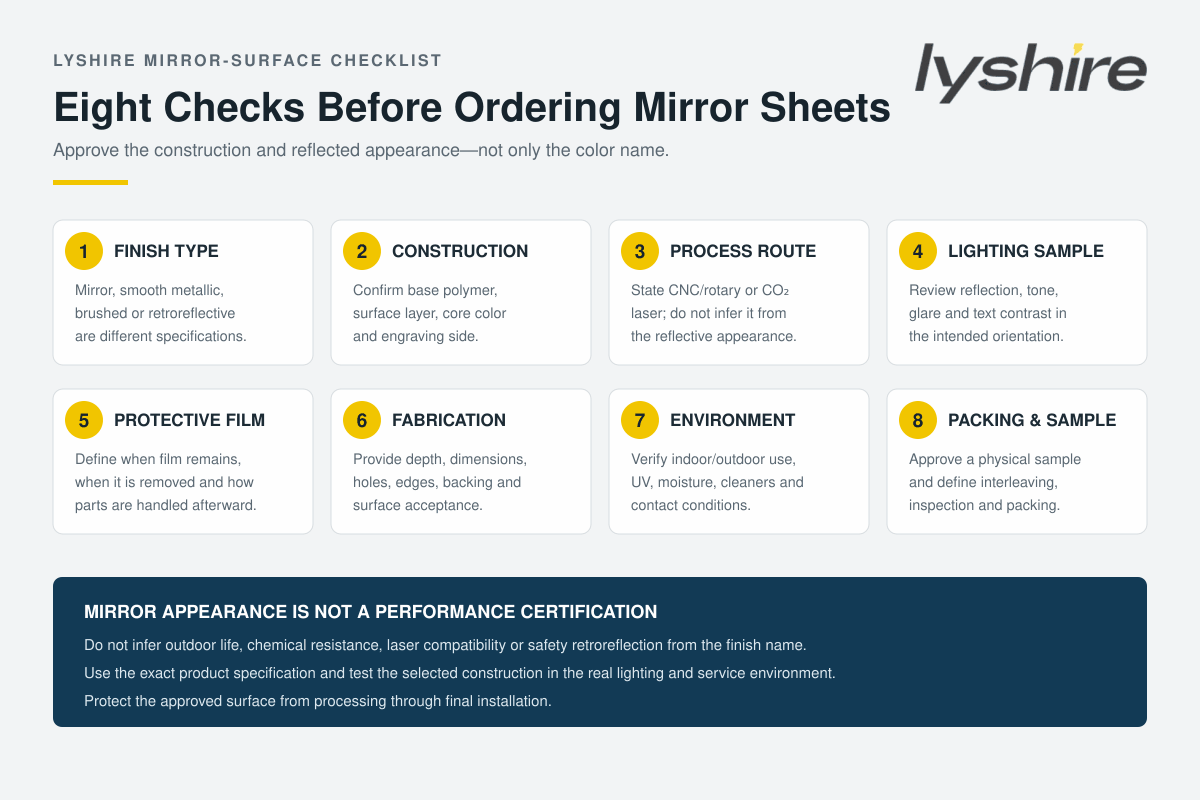
Quick answer: specify the exact mirror construction, base polymer, face/core colors, front or reverse engraving side, CNC/rotary or CO2 laser route, thickness, protective-film plan, fabrication, backing, service environment and packing. Approve a physical sample under the intended lighting because reflection and apparent color change with angle and surroundings.
“Mirror” describes an appearance, not one material
The term mirror engraving sheets may refer to different constructions. One product can use a metallic-looking surface layer over a contrasting engraving core; another may be mirror acrylic; a third may use a coating designed for reverse engraving. These products can look similar in a small online image while requiring different processing, engraving direction and service limitations.
Trotec describes metallic-looking engraving laminates whose effect is created by a laminate foil over a contrasting core. Gravotech separately offers mirror acrylic that can be engraved on the top or, for that specific product, from the back. These official examples demonstrate why buyers should request the exact construction rather than transfer one supplier’s instructions to every mirror-finish sheet.
For LYSHIRE, identify the specific model and intended process. Standard ABS configurations belong to the CNC/rotary route, while CO2 laser projects normally use the separate PMMA/acrylic-based laser configuration. A reflective face does not by itself establish laser compatibility.
Separate mirror, brushed, smooth metallic and retroreflective finishes
| Finish term | Visual behaviour | What the buyer should verify |
|---|---|---|
| Mirror finish | Shows strong specular reflection and surrounding shapes or colors | Reflection quality, tone, glare, construction, surface protection and viewing angle |
| Smooth metallic | Metal-like lustre with a smoother visual field, but not necessarily a clear mirror image | Exact sample, color, contrast, construction and service rating |
| Brushed metallic | Directional linear texture that diffuses reflection | Grain direction, part orientation, batch consistency and fabrication layout |
| Gloss solid color | Shiny colored surface without a metallic mirror effect | Gloss level, glare, face/core colors and scratch acceptance |
| Retroreflective material | Returns light toward its source for visibility applications | Specific reflective technology, certification, test method and intended safety use |
Mirror finish and retroreflection are not interchangeable. Rowmark’s Reflect-R-Mark, for example, is a specific highly reflective product presented for visibility signage and supported by its own outdoor claims. A decorative mirror engraving plastic must not be used as a safety-grade reflective material unless the exact product has the required specification and approval.
Approve a physical sample in the real lighting
A mirror gold or mirror silver sheet can photograph differently under warm lamps, cool LEDs, daylight or a dark studio. It also reflects clothing, ceilings, windows and nearby colored objects. Therefore, a web image or color chart is useful for selection but cannot fully define the installed appearance.
Review the sample at the intended angle and viewing distance. Check whether the reflected surroundings improve the design or make the engraving difficult to read. Highly reflective surfaces may create glare near spotlights or windows. For wayfinding, instructions or other information that must remain readable, compare mirror material with brushed or matte alternatives under the real conditions.
Place the engraved sample next to nearby metals, plastics and paint finishes. “Gold” can range from pale champagne to deeper yellow tones; “silver” can appear cool or warm depending on the environment. Record the approved sample, model and batch reference rather than relying only on a general color name.
Confirm face, core and engraving direction
Two-ply mirror engraving sheets normally create contrast by removing a face layer to expose a different-colored core. A gold/black sheet, for example, should be specified as gold face over black core, not simply “gold and black.” Reversing those two colors produces a different product and visual result.
Some mirror materials are designed for front engraving; some transparent or coated constructions can be reverse engraved. Reverse engraving may require mirrored artwork so it reads correctly from the viewing side. Do not mirror the file or engrave from the back unless the selected construction requires it.
Include a small face/core diagram or approved sample with the order. If the project combines mirror, brushed and matte parts, label every artwork and packing group by finish and orientation so similar colors are not mixed.
Select the processing route before machine settings
For LYSHIRE’s standard route, ABS mirror engraving sheets should be evaluated for CNC routing or rotary engraving, while PMMA/acrylic-based mirror engraving sheets intended for CO2 laser work belong to the laser configuration. The operator should use the data for the exact model rather than assuming all metallic finishes behave alike.
With laser processing, excessive energy can affect a sensitive surface, edge or protective film. With mechanical engraving, cutter geometry, sharpness, runout, depth and chip removal influence line quality and the chance of dragging debris across the face. Test the smallest text and most critical contour before running a batch.
Review the LYSHIRE processing system and engraving sheet structure system when choosing between CNC/rotary and laser routes. If finished parts are required, provide the artwork, dimensions and acceptance requirements for review.
Control engraving depth and contrast
The objective is to remove the mirror face cleanly and reveal the core without cutting unnecessarily deep. Too little removal can leave reflective residue inside characters. Excessive depth may widen fine details, increase processing time or create an edge that no longer matches the approved appearance.
Use a representative sample containing the smallest text, thinnest stroke, tightest spacing and largest engraved area. Check the result from different angles because a highly reflective face can make small traces of residue more visible. Record the accepted setting with the material model, thickness and equipment.
Engraving depth values published for another brand or construction are not universal. Surface-layer thickness, base material, machine and desired result vary. Start from the exact product information and adjust through controlled testing.
Plan protective-film handling before fabrication
A mirror surface makes fingerprints, fine scratches and dust easier to see under directional light. Protective film can help during transport and fabrication, but whether it remains during engraving or cutting depends on the exact film, material and process. Film that lifts, melts, traps residue or affects focus should not be left in place automatically.
Define when the film will be removed and who becomes responsible for the exposed face. If film is removed for processing, use clean gloves, a debris-free table and non-abrasive interleaving. Do not slide finished parts across each other. Separate chips before stacking, and avoid placing tools or metal fasteners on the mirror face.
For customer delivery, indicate whether parts arrive with film intact, partially removed or fully removed after inspection. The packing method should allow the installer to identify each part without peeling the visible face unnecessarily.
Cutting, holes and edge requirements
The drawing should define finished width and height, thickness, corner radius, holes, slots, cutouts and dimensional tolerances. If the surface layer can show at the edge, approve the edge appearance with the sample. Small tabs, burrs or film remnants that are acceptable on an internal component may be noticeable on a premium plaque.
For CNC work, plan toolpaths and hold-down so chips do not become trapped under the sheet or rub across finished areas. For laser cutting, verify whether the selected mirror construction is approved for the laser source and whether the edge needs cleaning or secondary finishing. Never process an unknown mirrored plastic solely because another visually similar sheet was laser compatible.
Specify hole clearance and fastener-head contact. Direct contact between a hard washer or screw head and the decorative surface may mark it during installation. A controlled fixing detail or protective washer may be required, subject to the assembly design.
Match adhesive backing to the installation surface
Adhesive-backed mirror engraving sheets can simplify installation on suitable flat substrates. The correct backing depends on the metal, paint, powder coating, plastic, texture, curvature, temperature and exposure. A premium face does not compensate for an adhesive that is unsuitable for the substrate.
Provide the actual installation surface and test the proposed construction before mass production. If the label must be repositioned, removed or installed over a curved area, state that requirement. Adhesive selection and surface preparation should follow the backing supplier’s guidance.
When appearance is critical, check whether adhesive thickness or an uneven substrate creates visible distortion in the reflected surface. A flat label may reveal dents, trapped particles or waves that are less visible on matte material.
Verify environmental and cleaning requirements
Do not infer outdoor durability, UV stability, moisture resistance, chemical resistance or flame performance from the word mirror. Trotec distinguishes metallic constructions intended for different exposure conditions, and Rowmark’s catalog similarly applies product-specific usage limits. The exact grade and test data control suitability.
State whether the part is indoors, sheltered or fully exposed, plus temperature range, sunlight, humidity, cleaning agents, oils, abrasion and expected service life. If the project has a documented test method, include it in the inquiry and verify that the selected material matches it.
Clean only with a method approved for the exact surface. Abrasive cloths, dry rubbing, aggressive solvents or unknown chemicals may haze, scratch or attack some constructions. Test the cleaning method on a sample before applying it to installed labels.
Inspection and packing for mirror surfaces
Inspect mirror engraving sheets under consistent diffuse and directional lighting. Look for scratches, pressure marks, coating defects, dust under film, engraving residue, incorrect face/core direction, dimensional errors and mixed finishes. A defect visible only at an extreme angle should be evaluated against an agreed acceptance standard rather than an undefined expectation.
Use clean interleaving and packaging that prevents movement during transport. Keep mirror faces from contacting cut edges, staples or loose hardware. Group finished parts by project or installation sequence and mark the outer packaging so the customer does not need to handle every exposed surface to find one item.
Common problems and what to check
| Observed problem | Specification or process items to review |
|---|---|
| Color looks different from the website | Lighting, viewing angle, surrounding reflections, display calibration and physical sample approval |
| Fine scratches appear after processing | Film decision, table cleanliness, chip control, gloves, stacking, interleaving and final handling |
| Engraving contains reflective residue | Depth, focus or cutter, material model, surface layer and cleaning method |
| Text is difficult to read | Glare, face/core contrast, character size, viewing angle and alternative brushed or matte finish |
| Mirror surface shows waves after installation | Sheet flatness, adhesive thickness, substrate flatness, trapped particles and installation pressure |
| Outdoor appearance changes prematurely | Exact grade, exposure rating, UV/moisture conditions, cleaner, edge protection and approval basis |
Material boundary: mirror appearance is not proof of outdoor performance, laser compatibility, chemical resistance or safety retroreflection. Confirm the exact LYSHIRE construction, intended processing route and project conditions before approval.
RFQ checklist for mirror engraving sheets
Send LYSHIRE the mirror color, required reflection style, face/core combination, finish sample, material model if known, CNC/rotary or CO2 laser route, thickness, full-sheet or finished-part format, artwork, smallest detail, holes and cutouts, front or reverse direction, protective-film expectation, backing, installation substrate, service environment, quantity, inspection and packing requirements.
For a custom finished-part project, include a PDF drawing and representative sample requirement. See LYSHIRE custom applications for nonstandard shapes, backing and fabrication review.
Frequently Asked Questions
Are mirror engraving sheets the same as brushed metallic sheets?
No. Mirror surfaces produce stronger specular reflection, while brushed finishes use a directional texture that diffuses the reflected image.
Does mirror finish mean the sheet is retroreflective?
No. Safety retroreflection is a separate product property that requires a suitable construction, specification and any required certification.
Can every mirror engraving sheet be laser processed?
No. Confirm the exact base polymer and product route. LYSHIRE’s standard ABS configuration is for CNC/rotary work; CO2 laser projects use the separate PMMA/acrylic-based configuration.
Should protective film remain during engraving?
It depends on the exact film, material and process. Test whether it protects the surface without lifting, melting, trapping residue or affecting the result.
Can adhesive backing be added?
Yes, subject to order review. Provide the real substrate, texture, curvature and service environment, and test the proposed backing before production.
How should mirror color be approved?
Approve a physical engraved sample under the intended lighting, angle and nearby colors, and record the exact model, finish and face/core combination.
Request a Mirror-Surface Sample Review
Send LYSHIRE the finish, face/core colors, process route, thickness, application, environment and quantity. The technical team can review the appropriate mirror engraving sheet and sample plan.
Contact LYSHIREMaterial references: Trotec materials catalog, Gravotech mirror acrylic, Rowmark Reflect-R-Mark and Rowmark product-specific material specifications.