

How to Specify Engraving Plastic Labels for Electrical Panels
How to Specify Engraving Plastic Labels for Electrical Panels
Electrical panel engraving labels should be treated as controlled engineering parts. A useful specification connects each label to the approved drawing, defines the material and processing route, and records dimensions, mounting and service conditions before production.
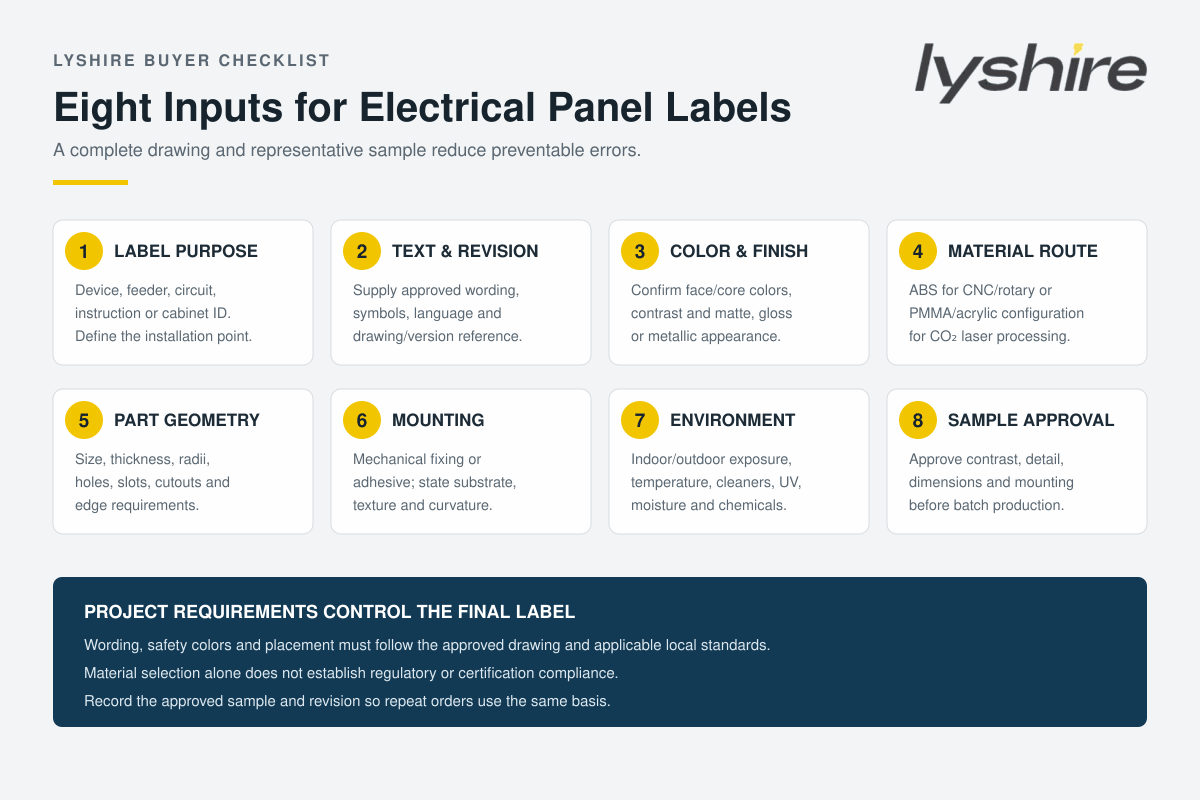
Quick answer: provide the exact label purpose, approved text and symbols, drawing revision, face/core colors, material route, finished dimensions, holes or adhesive, installation surface, service environment, quantity and acceptance sample. Do not use material selection as a substitute for the electrical designer’s code, certification or risk-assessment requirements.
Why an electrical panel label is more than a piece of text
A control cabinet may contain disconnecting means, feeders, breakers, selector switches, indicator lamps, terminals, maintenance instructions and multiple voltage systems. Electrical panel engraving labels around these components help operators and technicians connect the physical device to a drawing, operating sequence or maintenance procedure. A visually attractive label is not useful if its wording is wrong, its position is ambiguous or it becomes unreadable in the real environment.
In the United States, OSHA 29 CFR 1910.303(f) states that certain disconnecting means and circuits must be legibly marked to indicate their purpose and that required markings must be sufficiently durable for the environment involved. This is an important design principle, but it does not mean that one plastic sheet automatically makes a panel OSHA-compliant. The equipment designer, panel builder and authority having jurisdiction must determine which rules apply, what each marking must say, and where it must be installed.
UL 508A is a separate standard for industrial control panels. UL Solutions explains that qualified panel shops need staff capable of interpreting and applying its requirements. LYSHIRE supplies engraving materials and can review finished-label requirements, but it does not replace the panel builder’s certification process or engineering responsibility.
Start with the approved identification schedule
The safest production input is a controlled label schedule or drawing, not text copied from an email or photograph. Give every item a unique reference that links it to the panel, location and drawing revision. If the order contains variable data, use one structured spreadsheet or approved artwork package with a clear row-to-part relationship.
Confirm capitalization, punctuation, units, voltage notation, abbreviations, line breaks, symbols and language. State whether characters must meet a minimum height or stroke width. If the label includes a serial number, equipment tag, QR code or barcode, provide the data format and verification method. The engraver should not guess engineering terminology or “correct” a code without written approval.
A revision field is particularly important for repeat orders. When a machine design changes, an old but visually similar label can create a maintenance error. Record the drawing number, revision, approval date and any superseded text, and keep obsolete labels physically separated from the released batch.
Define the function of each label type
| Label group | Typical information | Specification questions |
|---|---|---|
| Pushbutton or selector legend | START, STOP, RESET, AUTO/MANUAL or process function | Does the text unambiguously match the adjacent device and operating position? |
| Breaker, feeder or disconnect ID | Purpose, circuit, destination or equipment reference | Which approved drawing defines the wording and location? |
| Terminal or component marker | Terminal number, device tag or wiring reference | What is the smallest readable text and how will variable data be controlled? |
| Instruction or caution plate | Operating sequence, maintenance restriction or hazard-related information | Which applicable standard or risk assessment controls wording, signal word, color and placement? |
| Cabinet or machine nameplate | Equipment ID, system name, asset number or project reference | Which fields are fixed, which are variable and which may require another certified label system? |
These groups can share a material family, but they do not necessarily share the same compliance role. For example, an engraved selector legend and a certification mark are not interchangeable. Never reproduce a certification mark, rating plate or regulated safety label without authorization and the applicable marking requirements.
Select the face and core colors from the project requirement
Two-ply engraving plastic creates contrast by removing a thin face layer and exposing a different-colored core. Common combinations such as black/white, red/white, yellow/black or white/black can produce clear identification, but the “best” color is not universal. Lighting, viewing distance, surface finish, contamination and nearby components all affect readability.
Safety colors and signal words must come from the applicable local standard, customer specification and engineering risk assessment. Do not assume that every red label means the same thing or that a familiar color combination is automatically compliant. For general device identification, select a contrast that remains legible under the installation lighting and test the smallest text at actual size.
Matte surfaces can reduce distracting reflections under cabinet lighting. Gloss and metallic finishes may be appropriate for branding or selected nameplates but should be evaluated for glare and fine-character visibility. If several panels belong to one machine family, define an approved face/core palette so replacement labels remain consistent.
Choose the material route before choosing machine settings
LYSHIRE separates the standard mechanical and laser material routes. Standard ABS engraving sheets are intended for CNC routing, rotary engraving, drilling, sawing and related mechanical fabrication. PMMA/acrylic-based laser engraving sheets are the normal route for CO2 laser engraving and cutting. A purchase description should state both the material construction and the intended process.
Laser-material suppliers such as Trotec describe two- and three-layer modified acrylic sheets with a thin top layer that is removed to reveal the core. Gravotech separately offers materials developed for rotary engraving and cutting. These examples show why “engraving plastic” alone is not a complete machine-compatibility statement. Parameters must be tested for the exact material, thickness, equipment, optic or cutter and required edge quality.
Choose a route by considering the smallest text, cut geometry, holes, edge appearance, cycle time and equipment available to the fabricator. If the labels will be supplied as finished parts, send the artwork and geometry to LYSHIRE for a process review. For an overview of the two routes, see the LYSHIRE processing system and the laser engraving sheet range.
Specify dimensions, thickness and fabrication details
The drawing should define finished width and height, thickness, corner radius, hole diameter, hole center positions, slots, cutouts, bevels and edge acceptance. State whether dimensions are nominal or controlled by a tolerance. Labels fitted around switches or indicator lamps need adequate clearance so they do not interfere with operation, sealing or service access.
LYSHIRE common thickness language includes 0.1, 0.3, 0.5, 0.8, 1.3, 1.5 and 3.0 mm, with 1.3 and 1.5 mm common for many rigid engraving applications. Availability and construction vary by product route; do not transfer one thickness list or tolerance to every material. Standard sheet language includes 600 × 1200 mm and custom-cut formats, while finished-part feasibility depends on the drawing, quantity and fabrication plan.
Thicker is not automatically better. A thicker plate may project farther from the panel surface, affect switch clearances or require different fixing hardware. A thin label may suit a flat adhesive application but needs suitable handling and substrate support. Review the complete assembly rather than selecting thickness from appearance alone.
Match the mounting method to the actual surface
Mechanical fasteners are often selected when the drawing already provides holes or when removal and replacement are expected. The specification should state hole size, countersink or counterbore requirements, fastener head clearance and whether cracking around holes is an acceptance concern.
Pressure-sensitive adhesive can speed installation on suitable surfaces, but its performance depends on the substrate, coating, surface texture, cleanliness, curvature, temperature and exposure. Powder-coated metal may be smooth or textured; two visually similar coatings may produce different bond results. Low-surface-energy plastics such as PP or PE require separate evaluation.
When requesting adhesive-backed electrical panel engraving labels, provide the actual installation substrate and whether it is flat, curved, painted or powder coated. Test the proposed backing on the real surface before mass production. The installer should follow the adhesive supplier’s preparation, pressure and dwell guidance.
Define the service environment without assuming durability
State whether the panel is indoors, sheltered outdoors or fully exposed. Include expected temperature range, sunlight or UV exposure, moisture, oil, cleaning chemicals, abrasion and maintenance frequency. A material suitable for a clean indoor cabinet is not automatically suitable for an outdoor enclosure or washdown area.
Outdoor suitability, flame performance, chemical resistance and cleaning resistance belong to the exact product specification and test conditions. Generic terms such as ABS, acrylic, matte or metallic are not performance certifications. If a project requires a particular rating or documented test method, include it in the request and verify the selected grade before approval.
Readability also changes with use. Labels near frequently operated controls may be touched or wiped more often than labels inside a locked cabinet. Position, protective geometry and cleaning practice can matter as much as nominal material properties.
Approve a representative sample and controlled proof
A proof should show the exact text, line breaks, symbols, face/core direction, dimensions, hole positions and quantity for every variable group. A physical sample should represent the smallest text, tightest spacing, most critical color combination, actual thickness and intended processing route. If adhesive is involved, test it on the actual surface.
Inspect the sample in the real viewing orientation and lighting. Confirm contrast, character completeness, engraving depth, edge quality, dimensional fit, hole alignment, surface condition and mounting. Record the accepted material model, colors, finish, tool or process route and drawing revision so production and repeat orders share the same reference.
A sample does not replace production inspection. The purchase agreement should define how the batch will be checked, how variable data will be reconciled, what quantity tolerance applies and how labels will be grouped and packed for installation.
Common problems and what to verify
| Observed problem | Items to review |
|---|---|
| Correct-looking label with wrong function | Drawing revision, label schedule, device reference, variable-data control and approval record |
| Fine text is incomplete or uneven | Face-layer removal, engraving depth, focus or cutter, smallest stroke and material/process compatibility |
| Label is hard to read under cabinet lighting | Face/core contrast, glare, finish, character size, viewing angle and actual illumination |
| Holes or cutouts do not fit the panel | Units, datum, drawing scale, hole centers, tolerance and sample fit check |
| Adhesive lifts from the corners | Surface texture, coating, contamination, curvature, installation pressure, temperature and adhesive selection |
| Replacement labels do not match | Material model, batch reference, finish, face/core colors, artwork revision and stored approved sample |
Compliance boundary: LYSHIRE can supply engraving plastic sheets and review custom fabricated labels, but the buyer or panel builder must define and approve all regulated wording, symbols, safety colors, placement, ratings and certification marks. Material selection alone does not establish compliance with OSHA, UL, IEC, NFPA or any other requirement.
RFQ checklist for electrical panel engraving labels
When requesting electrical panel engraving labels, send the label schedule and released drawing; panel and installation reference; exact wording, language and symbols; variable data; face/core colors and finish; ABS/CNC or PMMA/CO2 laser route; thickness; finished dimensions; holes and special shapes; mounting method; actual substrate; environment; quantity; packaging groups; and required sample or inspection record.
For finished parts, identify which labels belong to each cabinet or machine so they can be packed in installation order. If the requirement is still at material-sheet stage, specify full-sheet or custom-cut format and review LYSHIRE’s engraving sheet structure system. For nonstandard shapes, multiple data sets or special backing, see custom applications.
Frequently Asked Questions
Can engraving plastic labels be used on electrical panels?
Yes, where the selected construction, processing, mounting and service conditions fit the project. The panel designer must confirm applicable marking and certification requirements.
Does a red or yellow engraved label automatically meet a safety standard?
No. Wording, color, symbol and placement must follow the applicable standard, customer specification and engineering risk assessment.
Should ABS or acrylic be selected for panel labels?
Choose by process and service requirement. LYSHIRE’s standard ABS route is for CNC/rotary work; CO2 laser projects normally use the separate PMMA/acrylic-based configuration.
Can LYSHIRE supply holes, rounded corners and special shapes?
These finished-part features can be reviewed against the drawing, quantity, material and processing route. Provide dimensions, tolerances and a representative sample requirement.
Can adhesive backing be added?
Yes, subject to order review. Specify the real substrate, texture, curvature and environment, and test the proposed backing on the actual installation surface.
What should be approved before mass production?
Approve the controlled artwork or label schedule plus a representative physical sample covering text, contrast, dimensions, holes, edge quality and mounting.
Prepare an Electrical Panel Label Request
Send LYSHIRE the approved drawing, label schedule, material/process route, dimensions, mounting surface, service environment and quantity. The technical team can review sheets, finished parts and a representative sample route.
Contact LYSHIRETechnical references: OSHA 29 CFR 1910.303, UL industrial control panel program, Trotec laser engraving plastic sheets and Gravotech rotary engraving materials.