
How to Choose a Laserable Plastic Sheet for CO2 Laser Work
How to Choose a Laserable Plastic Sheet for CO2 Laser Work
A laserable plastic sheet should be selected by its exact material grade, layer construction and verified processing route—not by color or the word “plastic” alone. Buyers also need to define engraving, cutting, thickness, finished format, mounting and service conditions before approving a production order.
Quick answer: For LYSHIRE projects intended for CO2 laser engraving and cutting, start with the separate PMMA/acrylic-based laser configuration. Confirm the face/core colors, finish, 1.3 mm or 1.5 mm thickness, sheet or finished-part format and application environment. Then test representative artwork on the actual machine before mass production.
What “laserable” should mean on a purchase order
“Laserable” should identify a material that its supplier has designed or approved for the specified laser source and operation. It should not be treated as a general property of all plastic sheets. Trotec, for example, describes its two- and three-layer laser sheets as acrylic-based materials developed for CO2 laser engraving and cutting. The beam removes a thin face layer to reveal the contrasting core, while vector cutting can produce the finished outline.
The machine source matters. CO2, fiber, UV and diode systems interact with materials differently. This guide focuses on CO2 processing because that is the relevant route for LYSHIRE's acrylic-based laser engraving sheets. If a buyer uses another source, the material and machine supplier must confirm compatibility separately.
Laser-grade acrylic and standard ABS are different order routes
LYSHIRE separates its standard PMMA/acrylic laser configuration from its standard ABS CNC/rotary configuration. This distinction prevents buyers from ordering an attractive color in the wrong base material and discovering the problem during production.
| Order route | Primary process | Buyer should confirm |
|---|---|---|
| PMMA/acrylic-based laser sheet | CO2 laser engraving and cutting | Exact laser grade, layer colors, thickness, engraving detail, cut edge and extraction |
| Standard ABS engraving sheet | CNC routing or rotary engraving | Cutter, depth, chip removal, edge quality, holes and mechanical fabrication |
Some manufacturers may validate particular products for more than one process. That does not make every ABS or acrylic sheet interchangeable. Compatibility belongs to the exact grade and technical specification, not only to the polymer name.
For mechanical work, review the LYSHIRE processing system. For the dedicated laser material range, see LYSHIRE laser engraving sheets.
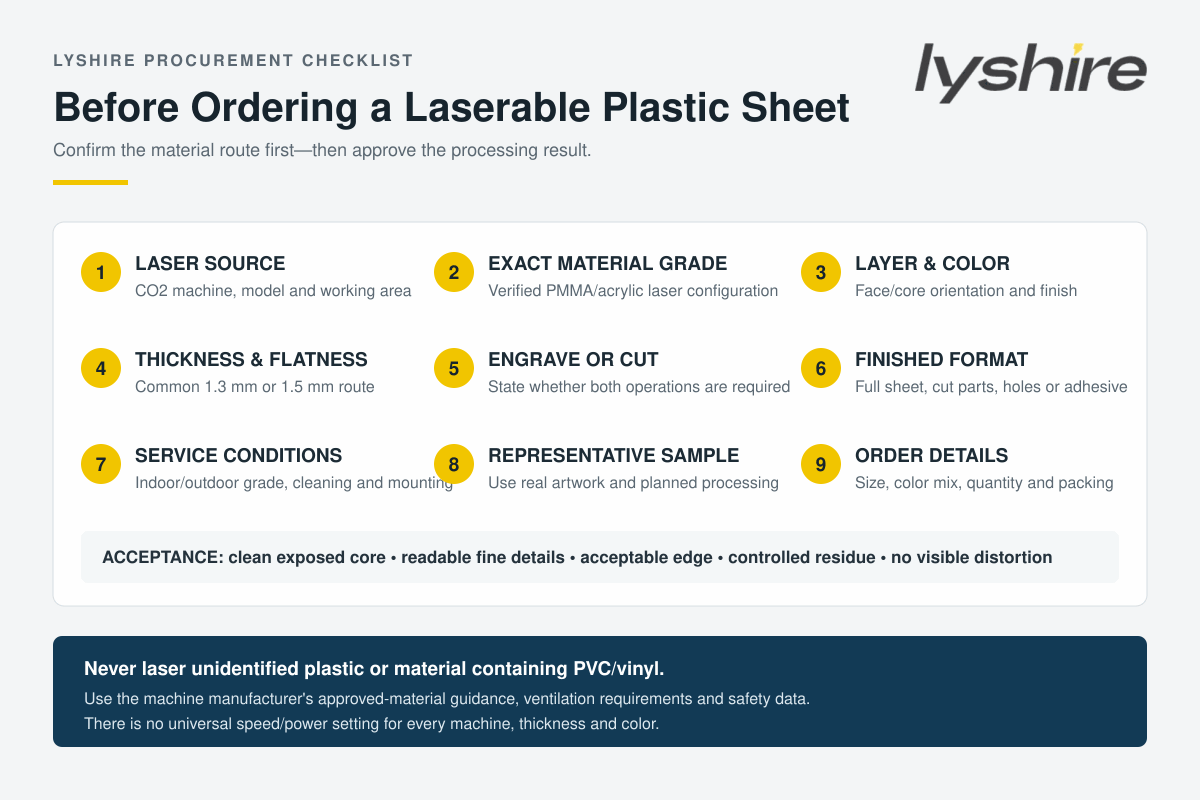
Nine checks before selecting a laserable plastic sheet
1. Confirm the laser source and machine
Tell the supplier that the project uses a CO2 laser and provide the machine model, rated power and working area when available. A sheet that performs on one system still needs parameter confirmation on another system because optics, actual power, lens, airflow, extraction and machine condition affect the result.
2. Identify the exact material grade
Request a clear description of the base structure and its intended process. “Acrylic appearance,” “engraving laminate” or “plastic sign sheet” is not enough. The order should link the selected color and finish to a verified PMMA/acrylic laser configuration.
Do not process unidentified plastic. PVC and vinyl must not be engraved or cut with a CO2 laser because hazardous and corrosive emissions can be produced. Epilog's equipment guidance explicitly prohibits PVC and vinyl. Buyers should also consult the machine manufacturer's approved-material guidance and the safety documentation for the exact sheet.
3. Define the layer construction and color direction
A two-ply surface-engraving sheet uses a thin face over a contrasting core. Engraving removes the face and exposes the core as the visible message. “Black/white” therefore means a black face with white engraved characters; “white/black” produces the opposite result. State the face color first and core color second.
If a project needs three colors, reverse engraving, double-sided construction or another structure, identify that requirement separately rather than assuming every laserable plastic sheet uses the same build. The LYSHIRE engraving sheet structure system explains the available routes.
4. Select thickness by the finished part
LYSHIRE's commonly used laser sheet thicknesses are 1.3 mm and 1.5 mm. Both can be suitable for equipment labels, nameplates, panel legends, signs and other identification parts, but the final choice depends on part size, handling, mounting and customer specification.
| Thickness | Typical selection reason | What to test |
|---|---|---|
| 1.3 mm | Common balance of sheet efficiency, handling and finished-label rigidity | Flatness, small-part handling, adhesive application and cut edge |
| 1.5 mm | Slightly greater stiffness or a drawing/customer requirement | Cut speed, heat input, hole quality, fit and installed profile |
Do not choose thickness only by a competitor's inch label. Nominal metric and imperial products are not automatically identical. Confirm the actual millimeter requirement and accepted tolerance on the drawing or purchase order.
5. Separate engraving requirements from cutting requirements
A project may need engraving only, cutting only or both. These are different acceptance points. Engraving should expose the core cleanly with legible fine detail. Cutting should produce an acceptable edge without excessive melt, residue or distortion. If both operations are required, the sample must include both.
Supply the smallest text, thinnest line, tightest internal corner, smallest hole and actual outer profile. A large sample word engraved in the center of a sheet does not prove that a dense control-panel legend or a small serial-number label will meet the job.
6. Confirm face finish and protective film
Matte, gloss, brushed, mirror and other special faces respond differently to light and handling. Metallic or mirror-effect surfaces may show fingerprints and scratches more readily, so the protective film, processing direction and cleaning method should be confirmed. Brushed finishes also require a consistent grain direction across related parts.
7. State the service environment
Laser compatibility does not automatically establish outdoor durability, UV performance, chemical resistance or compliance with a specific standard. Indoor and outdoor requirements must be attached to the exact product grade. Buyers should state expected sunlight, temperature, moisture, cleaning agents and required service documentation before selection.
8. Define sheet, backing and fabrication format
Confirm whether the order requires full sheets, cut blanks or finished parts. LYSHIRE's common full-sheet supply is nominal 600 × 1200 mm. Alternative 305 × 610 mm, 610 × 1220 mm and custom-cut formats are separate specifications and should not be treated as interchangeable.
List holes, rounded corners, engraving, variable data, adhesive backing and packaging requirements. Adhesive selection also depends on the installation substrate, texture, curvature and environment; it is not determined by the laser sheet alone. Buyers needing completed parts can use the LYSHIRE custom application service.
9. Approve a representative physical sample
Run the sample on the intended machine with the actual artwork and planned extraction. Parameter tables are starting references, not universal production settings. Epilog notes that different materials require different speed, power and frequency settings; the final combination also changes with machine power, thickness and color.
Record the approved settings and keep the sample for comparison. For repeat production, the buyer and supplier should agree on the important acceptance points: exposed-core clarity, fine-detail readability, residue, cut edge, visible distortion, dimensions and appearance after cleaning.
A simple sample-test sequence
- Confirm the sheet identity and remove only the protective film required for the test.
- Check focus, lens condition, table support and extraction according to the machine manual.
- Engrave a controlled matrix around the supplier's starting range instead of relying on one setting.
- Inspect whether the face is removed consistently without unnecessary penetration into the core.
- Cut the real outline, holes and internal corners when the project requires fabrication.
- Clean the part using the approved method and recheck color, edge, residue and fine details.
- Retain the accepted sample, settings and material identification for the production batch.
What common test problems can indicate
| Observed result | Items to review |
|---|---|
| Face color remains inside characters | Focus, energy density, speed, artwork fill and whether the material is the correct laser grade |
| Core looks deeply gouged or rough | Excessive energy, repeated passes, resolution, focus and face-layer removal strategy |
| Dark residue or smoke marks | Extraction, airflow, protective film, excessive heat, cleaning method and test layout |
| Melted or rounded cut edge | Power/speed balance, frequency, focus, number of passes, table reflection and sheet grade |
| Fine text closes or loses definition | Font, stroke width, resolution, spot size, focus, energy and actual face-layer behavior |
| Part does not remain flat | Heat accumulation, cutting order, support, part geometry, thickness and material condition |
Safety boundary: never use odor, flame color or a trial laser pass to identify an unknown plastic. Obtain reliable material identification and follow the laser manufacturer's instructions for approved materials, ventilation, fire monitoring and operation.
Laserable plastic sheet RFQ checklist
A useful RFQ should provide the CO2 laser model, intended engraving and cutting operations, base-material requirement, face/core colors, finish, thickness, sheet or finished-part size, artwork, holes and corner details, backing, service environment, quantity and acceptance test.
LYSHIRE's standard MOQ is 500 sheets, and standard colors may be mixed subject to order confirmation, availability and packing multiples. State the quantity of every color combination separately. Custom colors, surfaces, thicknesses or constructions require an additional feasibility and quantity review.
Frequently Asked Questions
Are all acrylic sheets laserable?
No. Acrylic is widely used with CO2 lasers, but the exact grade, additives, surface construction and required result must be verified. Use material approved for the intended process.
Can LYSHIRE standard ABS engraving sheets be used as the default CO2 laser sheet?
No. LYSHIRE's standard ABS configuration belongs to the CNC/rotary route. CO2 laser projects should start with the separate PMMA/acrylic-based laser configuration.
Is 1.3 mm or 1.5 mm better?
Neither is universally better. Choose according to the finished-part stiffness, drawing, mounting method, cutting requirement and customer specification, then test the selected thickness.
Can one laser setting be used for every color?
No. Color, finish, thickness, material grade and machine condition can change the result. Test and record each relevant configuration.
Should the sample include laser cutting?
Yes, when production parts will be laser cut. Engraving quality alone does not confirm the edge, hole, corner or dimensional result.
Can adhesive backing be added before laser processing?
It can be supplied for suitable projects, but the exact sheet, adhesive, laser process, extraction and installation surface must be reviewed. Test the backed construction before mass production.
Request a Laser Sheet Sample Review
Send LYSHIRE the machine, material, thickness, colors, artwork, finished format, application and quantity. The technical team can identify the relevant laser configuration and prepare a representative sample route.
Contact LYSHIRETechnical references: Trotec laser engraving plastic sheets, Trotec laser material overview, Gravotech engraving material guide, Epilog material settings guidance and Epilog PVC/vinyl warning.