
How to Evaluate Alcohol Wipe Resistance in Engraving Plastic Labels
Industrial labels may be wiped during equipment cleaning, maintenance or routine handling. For buyers of engraving plastic, the useful question is whether the selected material keeps its surface appearance and engraved information under the cleaning conditions of the actual application.
An alcohol wiping demonstration can provide a first check. Its value depends on knowing what was tested, how it was wiped and what was inspected afterwards. A result for one sample should stay connected to that sample and procedure.
Quick answer: what should buyers check?
When evaluating alcohol wipe resistance in engraving plastic labels, record these five inputs:
- Material: product identification, face/core colors, finish, thickness and batch where available.
- Cleaning liquid: exact product and stated alcohol concentration.
- Procedure: wiping cloth, stroke count, pressure, contact time and any drying or inspection interval.
- Test area: the original surface, engraved lettering and other features relevant to the finished label.
- Acceptance: which visible or functional changes would make the label unsuitable.
Keep any missing conditions marked as unknown. That makes the result easier to interpret and helps prevent an informal demonstration from being mistaken for a fully specified laboratory test.
What LYSHIRE's recorded demonstration showed
In LYSHIRE's recorded wiping demonstration, an engraving plastic sample was wiped back and forth approximately 70–80 times using 95% alcohol. No visible surface change was observed on the tested sample after the demonstration.
Result boundary: This is an observation from the recorded demonstration. It is not a universal approval for every color, construction, alcohol formulation or industrial cleaning liquid. It does not establish a service lifetime, a disinfection result or compliance with a formal chemical-resistance standard.
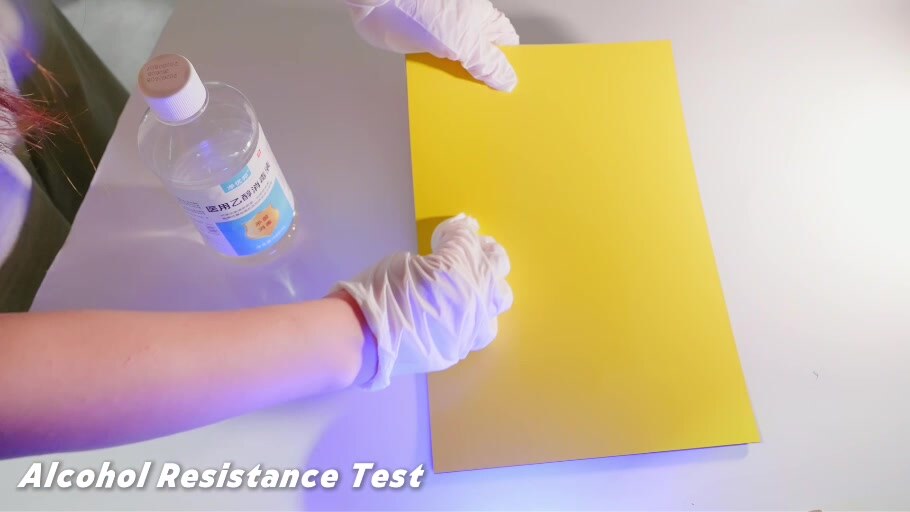
Recorded alcohol wiping demonstration on a yellow LYSHIRE engraving plastic sample.
For a purchasing decision, connect the demonstration to the exact material being quoted. Where a documented result is required, agree the specimen identification, cleaning liquid, procedure and acceptance criteria before testing.
Define the cleaning conditions in the enquiry
A request for “alcohol-resistant labels” leaves important details open. A brief maintenance wipe and prolonged contact are different exposure scenarios. The actual cleaner may also contain ingredients beyond alcohol.
Send the supplier the cleaning product name, its label or technical information, the stated concentration and the way it will be used. Include wiping frequency, expected contact time and whether the label is cleaned while mounted on equipment. If more than one cleaner is used, list each one separately.
Do not use a result from one cleaning liquid to approve another. An alcohol wiping result also does not approve immersion, strong solvent exposure or a different cleaning procedure.
Evaluate the finished label as well as the sheet
A surface demonstration is useful, but buyers should also review a representative engraved label. Include the smallest text, narrow lines and the actual face/core combination used in production. If adhesive backing is part of the order, include the agreed backing and mounting substrate in the application review.
For LYSHIRE projects, specify acrylic (PMMA) engraving sheets for the standard CO2 laser route, or ABS sheets for rotary/CNC engraving. Processing compatibility and cleaning resistance are separate requirements; both should be confirmed for the selected configuration.
Typical projects include the industrial labels and equipment identification applications described on our website. Select the material against the actual process and environment rather than transferring a broad performance claim to an entire product range.
A practical sample-evaluation checklist
The following checklist is a proposed purchasing workflow. It describes what to record in an agreed evaluation; it does not add unrecorded conditions or results to LYSHIRE's earlier demonstration.
- Identify the sample. Record the selected construction, colors, finish, thickness, engraving process and backing where relevant.
- Agree the procedure. Define the cleaning liquid, concentration, wiping material, stroke definition, count, pressure and contact time. State whether one back-and-forth movement counts as one cycle.
- Record the starting appearance. Photograph the surface and engraved details under consistent light and at a repeatable angle.
- Carry out the agreed evaluation. Keep the conditions consistent and retain the original record or footage.
- Inspect against agreed criteria. Compare appearance and legibility, then review any mounting or backing requirements separately.
- Keep the approval record. Retain the sample reference, procedure, photographs and written acceptance with the order specification.
Surface structure is also relevant when interpreting wiping performance. In the magnified view below, the LYSHIRE sample shows a finer and more compact surface appearance than the other sample shown in the recorded footage. This difference may help explain the observed alcohol-wiping performance, but the image alone does not establish a chemical-resistance rating or a universal result for all products.
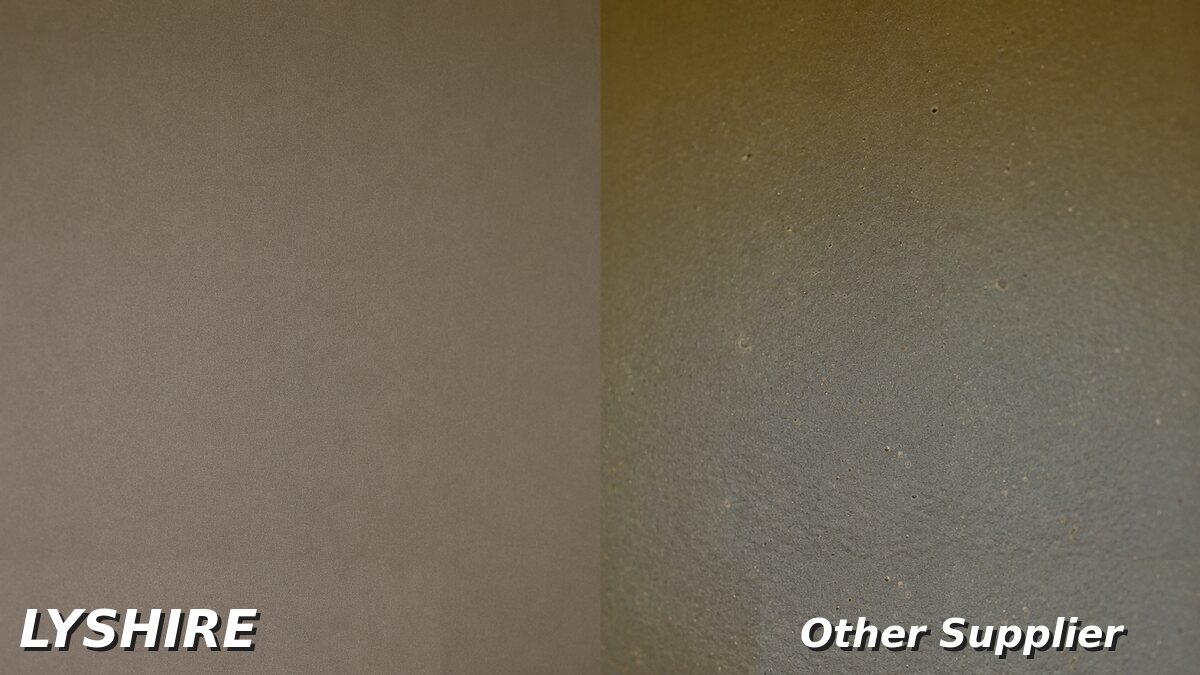
Magnified surface detail from the recorded comparison: a finer LYSHIRE surface appearance is shown beside the other sample's more textured surface. Lighting artifacts have been removed for clarity; the underlying surface features are retained.
What should be inspected after wiping?
- Visible color change, haze, whitening or a change in surface gloss.
- Surface marks or other changes compared with the original photograph.
- Legibility of the smallest engraved text and contrast between face and core.
- Visible cracking, lifting or separation where relevant to the construction.
- Backing and attachment performance when an installed label is being evaluated.
These are inspection items, not additional claimed results from the recorded demonstration. A visual check alone does not measure every material property. If a project requires numerical limits or certification, define those requirements and arrange suitable testing for the exact product.
Frequently asked questions
Does an alcohol wiping demonstration prove resistance to all chemicals?
No. The result applies to the tested sample, liquid and procedure. Other cleaners, solvents and exposure conditions need their own evaluation.
Does 70–80 back-and-forth wipes represent a fixed number of service years?
No. Wipe count is part of a procedure, not a direct conversion to service life. Actual cleaning frequency, liquid, pressure, contact time and environmental exposure must be considered.
Should buyers test an engraved sample?
Yes. A representative sample allows the surface, smallest lettering, contrast and relevant fabrication features to be reviewed together. Test the actual backing and mounting arrangement when those are part of the application.
Does cleaning resistance confirm outdoor suitability?
No. Cleaning exposure and outdoor weathering are separate requirements. For exterior projects, also review the exposure, installation and available product-specific evidence. See our guide to evaluating UV-resistant engraving plastic for outdoor labels.
Information to send for a material review
Send LYSHIRE the application, engraving process, face/core colors, finish, thickness, sheet or finished-label size, backing, mounting substrate and expected quantity. Add the cleaner name, concentration, contact method, cleaning frequency and acceptance criteria.
These details help us review the requested construction and discuss a representative sample evaluation before bulk purchasing.
Review your label material and cleaning requirements
Share your engraving process, material requirements and intended cleaner so LYSHIRE can review the application and discuss suitable samples.
Test note: The result described above is a visual observation from LYSHIRE's recorded 95% alcohol wiping demonstration on a tested sample. No universal chemical-resistance rating, disinfection efficacy, formal test certification or service-life claim is made.